Companion vs. Teething Dog Plush Toys: A Head-to-Head Retail Assortment Decision

A plush pet toy production environment where companion and teething dog plush toy lines are manufactured. Photo: Tianchang Jiameile Gifts Co., Ltd.
Retail decision in one line: companion plush and teething plush are not interchangeable SKUs. A companion dog plush toy is planned for daily companionship, cuddling and emotional calming, and is normally specified for light chewers in short plush at 10–15 cm and 15–20 cm. A teething plush toy is planned for teething and chew training, and must be graded by chew level (light, moderate, aggressive) and dog weight (5–40 kg), using reinforced stitching, Oxford fabric or food-grade TPR, with a 12–24 month service life for reinforced chew-resistant construction. Both roles share one compliance base: non-toxic, lead-free and phthalate-free materials that conform to EN71, CPSIA and GB/T 43839-2024.
Both items sit side by side in the same aisle, arrive in similar packaging and often share a supplier. Yet they answer two different buyer questions: will my dog cuddle this? and will this survive my dog? Answering only one of those questions in an assortment is what produces dead stock on one side of the shelf and repeat orders on the other.
The Assortment Problem: Two Plush Toys, Two Buyer Promises
Buyers rarely get the material wrong. They get the job wrong. A soft dog plush toy for cuddling is purchased to reduce stress, give a dog something to carry and support rest. A plush puppy teething toy is purchased because a puppy is actively chewing and the owner needs to redirect that behaviour away from furniture, cables and shoes. Both are plush, both may contain an interactive squeaker, and both may be listed in the same wholesale plush dog toy catalogue.
Failure appears when a single SKU is asked to serve both jobs. A lightweight companion plush with standard stitching, placed in a household with a 20 kg moderate chewer, generates the failure reports that damage a private label: seams opened early, filling pulled out, squeaker removed within days. The reverse also happens: a heavily reinforced chew toy sold as a cuddle companion can be rejected by owners of small puppies as too firm for a sleeping toy.
The fix is procedural, not creative. Chew level and dog weight should be assigned before price points, shelf facings or subscription-box slots are decided. Within the Jiameile plush pet toy range, those two variables are already separated as standard attributes: suitable dog weight is listed as <5 kg, 5–15 kg and 15–30 kg, chew resistance is listed as light, moderate and aggressive, and the overall product scope covers dogs from 5–40 kg.
Industry Background: Why the Plush Aisle Is Being Re-Graded in 2026
The global dog toys market was estimated at USD 4.16 billion in 2025, with a projected CAGR of 8.51% over the 2025–2034 period according to Custom Market Insights. Stuffed toys representing animals are classified under HS code 9503.00.41 for customs purposes (TariffNumber.com), which is the code importers and cross-border e-commerce sellers use when the plush portion of that spend crosses a border.
Compliance expectations have tightened alongside that growth. EN71, ASTM F963 and CPSIA are the standards most frequently named for pet toy and toy safety checks (Newtoppets), and general pet toy guidance from the American Humane Society is to choose durable, non-toxic materials and avoid items that splinter or contain parts small enough to be swallowed. Applied to plush, that guidance converts into three procurement habits: material declarations covering lead and phthalates, stitching and seam verification, and chew-level grading matched to dog weight rather than to price band.
This is why the companion-versus-teething split has moved from a merchandising preference to a specification decision. Retail chains, pet e-commerce sellers and subscription box operators now ask for the chew level of a plush SKU in the same way they once asked only for size and colour.
The Shared Specification Baseline: What Both Lines Must Meet
Before the two roles diverge, they share one specification floor. A buyer should be able to apply the following baseline to every plush SKU in the range, regardless of whether it is positioned as a companion item or a teething item:
- Materials: food-grade TPR that is lead-free and phthalate-free, short plush, and Oxford fabric, depending on format and chew level.
- Core sizes: 10–15 cm and 15–20 cm for small formats, 20–30 cm for medium formats and 30–50 cm for large formats.
- Weight suitability: graded in bands of <5 kg, 5–15 kg and 15–30 kg, with the wider product scope covering dogs from 5–40 kg.
- Chew rating: light chewer, moderate chewer and aggressive chewer designations.
- Compliance: GB/T 43839-2024 “Safety Technical Requirements for Companion Animal (Pet) Products”, plus EN71 and CPSIA for export markets, and manufacturer-level conformity with EN71, ASTM F963 and GB6675.
- Durability expectation: an average service life of 12–24 months for the reinforced chew-resistant series, compared with roughly 3–12 months for standard plush and 12–36 months for rubber or TPR constructions depending on usage intensity.
- Build features: reinforced stitching, washable construction, an optional no-stuffing design, and an interactive squeaker where the SKU calls for it.
Because this baseline is common to both roles, the differentiation cannot be made on compliance. It has to be made on construction and on the buyer job the SKU is designed to perform.

Plush toy production floor. Seam construction and stuffing choice are the two variables that separate companion plush from reinforced teething plush.
Companion Plush Toys: The Calming and Comfort SKU
A companion plush is a comfort product. Its purchase drivers are emotional: anxiety relief, daily companionship and interaction. In the Jiameile line, the reinforced stitching plush range and the standard plush range are both applied to companionship, emotional calming and interactive play, and the broader case record lists daily companionship, emotional calming or anxiety relief, interactive play and reduction of destructive behaviour as core applications.
Typical companion specifications look like this:
- Chew level: light chewer, and light-to-moderate for dual-purpose SKUs.
- Dog weight band: <5 kg and 5–15 kg, which covers puppies and small breeds.
- Size: 10–15 cm and 15–20 cm, with short plush as the standard surface material.
- Build options that matter commercially: no-stuffing construction for safety-conscious buyers, washable plush for hygiene-driven households, and an interactive squeaker for engagement.
- Expected service life: in the standard plush band, roughly 3–12 months depending on usage intensity.
For a retail buyer, the companion SKU is the entry point that builds category penetration. It is the item a first-time puppy owner buys, the item that fits a calming or gifting bundle, and the item that keeps price-sensitive shoppers inside the plush fixture. Its commercial risk is not failure to sell — it is being reordered for the wrong dog.
Teething Plush Toys: The Chew-Training SKU
A teething plush is a behaviour-management product. It exists because a puppy or young dog is chewing, and the owner wants a targeted outlet for that behaviour. The applications listed in the Jiameile case record for this product family are teething and chewing training, behavioural training and reduction of destructive behaviour — a materially different job from calming.
Typical teething specifications look like this:
- Chew level: moderate to aggressive, supported by reinforced stitching technology.
- Dog weight band: 5–15 kg, 15–30 kg, and the wider 5–40 kg scope for larger breeds.
- Size and material by format: 20–30 cm in Oxford fabric for medium formats, and 30–50 cm in TPR for large formats.
- Safety specification: food-grade TPR, lead-free and phthalate-free, compliant with GB/T 43839-2024, EN71 and CPSIA.
- Expected service life: an average of 12–24 months for the reinforced chew-resistant series, with rubber and TPR constructions extending to 12–36 months depending on usage intensity.
For a retail buyer, the teething SKU carries the replacement cycle. A durable plush dog toy that survives past the first month converts an owner into a repeat buyer, and the case record for this product family reports a repeat purchase rate above 85%, with some long-term customers purchasing more than 100,000 pieces annually. That number is not driven by softness; it is driven by the SKU doing what the label promised.
Chew Level × Dog Weight: The Grid That Decides the SKU
Chew level alone does not settle the assortment question, and neither does dog weight alone. The two must be read together. The planning grid below maps the weight bands and chew levels used in the Jiameile plush pet toy line onto a shelf-ready assortment role.
| Dog weight band | Chew level to plan for | Size to stock | Assortment role |
|---|---|---|---|
| Under 5 kg | Light | 10–15 cm short plush | Companion, calming, first-toy purchase |
| 5–15 kg | Light to moderate | 15–20 cm short plush | Dual-purpose entry SKU; can carry either role |
| 15–30 kg | Moderate to aggressive | 20–30 cm Oxford fabric | Teething and chew-training SKU |
| Roughly 30–40 kg | Aggressive | 30–50 cm TPR construction | Heavy-chewer replacement SKU |
Treat this as a planning framework built from published product attributes, not as a laboratory ranking. Its value is that it prevents the single most common assortment error: stocking companion-grade short plush in the weight band where a reinforced teething construction is required.
Step-by-Step: How to Build the Companion and Teething SKU Mix
Step 1 — Fix the weight bands before the price ladder
Start with <5 kg, 5–15 kg and 15–30 kg, and decide whether the upper 30–40 kg range is part of this buying cycle. Weight bands determine which construction is even eligible, so they must be set before price points are negotiated.
Step 2 — Assign a chew level to every SKU
Label each item as light, moderate or aggressive and make the label visible on the packaging and the listing. A plush SKU without a chew rating forces the shopper to guess, and guessing produces returns for both roles.
Step 3 — Match material and size to the role
Short plush at 10–15 cm and 15–20 cm suits companionship and calming. Oxford fabric at 20–30 cm and TPR at 30–50 cm suit teething and chew training. This single decision removes most of the overlap between the two lines.
Step 4 — Verify the compliance package, not just the claim
Ask for the certificate number, the issuing authority, the standard, the scope and the expiry date. As an example of the level of documentation a supplier can hold: the ISO 9001 quality management certificate 00124Q35906R5M/3400 for Tianchang Jiameile Gifts Co., Ltd., issued by CQC under GB/T19001-2016, covering the production of cloth and plush toys, valid until 2027-09-01. Product-level conformity with GB/T 43839-2024, EN71 and CPSIA should be presented separately from the factory management certificate.
Step 5 — Set the SKU mix ratio and shelf position
Companion plush and teething plush should not be facings of the same SKU with different labels. Give each role its own facing, and place the companion item where first-time and small-breed owners shop, with the reinforced teething item adjacent to it in the same weight band so the upgrade path is visible.
Step 6 — Define the supplier questions and the sample test
Before the first purchase order, confirm reinforced stitching construction, stuffing versus no-stuffing, squeaker type, washability and size grading. Then test the sample against the dog weight band it is being sold into, not against the average consumer.
Shelf Positioning and Channel Fit: Where Each SKU Earns Its Space
The companion-versus-teething split behaves differently across channels, and the channel determines which role deserves more facings.
- Pet subscription boxes: sequence the two roles over time rather than mixing them in one box. A companion plush fits an early or calming box; a plush puppy teething toy fits the box that follows the chewing phase. Jiameile's plush pet toy applications include pet subscription box companies, alongside pet brands, private label brands, wholesalers, cross-border e-commerce sellers, retail chains and Amazon sellers.
- Pet retail chains and supermarkets: separate facings by weight band, then by role, so a shopper with a 20 kg dog is not routed to a 10–15 cm companion SKU.
- Amazon and DTC stores: bundle a companion item with a teething item in the same weight band, and state chew level in the title bullet rather than only in the specification table.
- Veterinary and pet care settings: calming plush fits post-visit comfort use, where the emotional job dominates.
- Training, boarding and pet hotel channels: reinforced teething plush fits structured chew-training and multi-day stay use, where durability dominates.
- Grooming and gifting: small-format companion plush at 10–15 cm works as a low-unit gift or add-on item.
Across all of these channels, the applicable industry set for this product family — pet supplies, pet e-commerce, pet brands, retail chains, veterinary and pet care, training, boarding and pet hotels, grooming, gifting, subscription boxes and supermarkets — uses the same two purchase triggers. One is comfort. The other is chewing.
Companion vs. Teething Dog Plush Toys: Head-to-Head Comparison
| Decision dimension | Companion plush | Teething plush |
|---|---|---|
| Primary buyer job | Daily companionship, cuddling, emotional calming and anxiety relief | Teething and chewing training, behavioural training, reducing destructive behaviour |
| Chew level | Light; light to moderate on dual-purpose SKUs | Moderate to aggressive, with reinforced stitching |
| Dog weight band | Mainly <5 kg and 5–15 kg | 5–15 kg and 15–30 kg, within a 5–40 kg scope |
| Typical size | 10–15 cm and 15–20 cm | 20–30 cm and 30–50 cm |
| Core material | Short plush | Oxford fabric; TPR for large formats |
| Durability expectation | Roughly 3–12 months for standard plush | 12–24 months for the reinforced chew-resistant series; 12–36 months for TPR |
| Safety baseline | Non-toxic, lead-free, phthalate-free; GB/T 43839-2024, EN71, CPSIA | Identical baseline, with food-grade TPR on chew surfaces |
| Build features | Washable, optional no-stuffing, interactive squeaker | Reinforced stitching, wear-resistant and tear-resistant construction |
| Shelf role | Entry and penetration SKU; comfort and gifting | Retention and replacement SKU; behaviour management |
| Buyer question answered | Will my dog stay calm and comforted? | Will this survive my dog's chewing? |
Read side by side, the two columns show why the assortment decision is a role decision, not a colour or size decision. The materials, sizes and durability figures differ because the jobs differ, while the compliance baseline stays the same.
Supplier Questions That Separate the Two Lines
Once the roles are defined, the supplier conversation becomes specific. Jiameile — the trading name of Tianchang Jiameile Gifts Co., Ltd., a plush and textile toy manufacturer based in Tianchang City, Anhui Province, China — produces plush pet toys, squeaky toys and interactive items with OEM and ODM support, and its reinforced stitching technology is the construction variable that separates its companion line from its chew-resistant line.
Questions worth putting in writing before sampling:
- Construction: Is reinforced stitching used, and on which seam positions? Jiameile applies reinforced stitching technology across its chew-resistant plush range.
- Grading: Which chew level and weight band is this exact SKU rated for? The range uses light, moderate and aggressive chew levels with <5 kg, 5–15 kg and 15–30 kg bands.
- Material declaration: Is the material food-grade TPR, lead-free and phthalate-free, and which standard does the declaration follow?
- Certification scope: Do you hold ISO 9001, ISO 14001, BSCI, ICTI or Disney FAMA, and what does the quality certificate actually cover? Jiameile's ISO 9001 certificate 00124Q35906R5M/3400, issued by CQC, is scoped to the production of cloth and plush toys and remains valid until 2027-09-01.
- Capacity and continuity: What monthly capacity can be committed? Jiameile operates a 6,800 m² facility with a reported monthly capacity of around 500,000 pieces and a 6 million piece annual output, exporting to the EU and USA among other markets.
- Customisation: Which variables can be changed — logo printing, fabric material, size, colour, stuffing type, squeaker type, packaging and hang tags?
- Quality control: Which inspection stages apply? Incoming, in-process and final inspection are standard, with third-party inspection such as SGS or BV available on request.
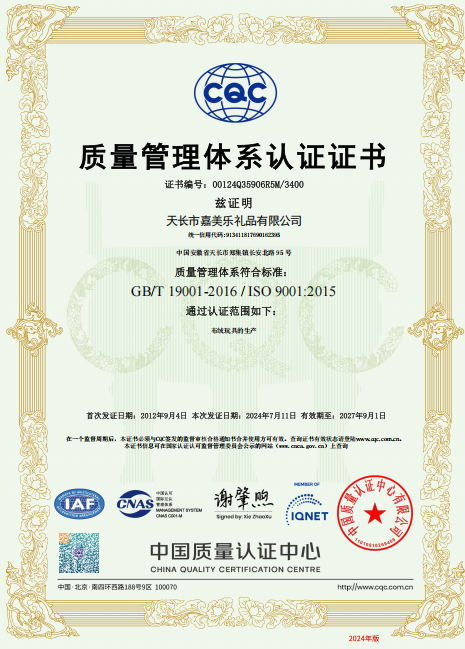
ISO 9001 QMS certificate 00124Q35906R5M/3400, issued by CQC under GB/T19001-2016, scope: production of cloth and plush toys, valid until 2027-09-01.
FAQ: Companion and Teething Dog Plush Toys for Retail Buyers
Which safety standards should a dog plush toy SKU meet for US and EU retail?
A dog plush toy sold into the US and EU markets is normally assessed against EN71 and CPSIA, and China-based production is additionally assessed against GB/T 43839-2024, the Chinese safety technical requirements for companion animal products. Manufacturers commonly also declare conformity with EN71, ASTM F963 and GB6675 at factory level. General pet toy guidance from the American Humane Society adds a practical screen: choose durable, non-toxic materials and avoid items that splinter or contain parts small enough to be swallowed. Documentation should include certificate number, issuing authority, scope and expiry date — for example, ISO 9001 certificate 00124Q35906R5M/3400 issued by CQC under GB/T19001-2016, covering the production of cloth and plush toys, valid until 2027-09-01.
Can one supplier deliver both companion and teething plush lines?
Yes, if the supplier can hold both construction types on the same production floor. A companion line requires short plush at 10–15 cm and 15–20 cm for light-chewing and small-breed SKUs, while a teething line requires reinforced stitching plus Oxford fabric at 20–30 cm and TPR at 30–50 cm for moderate and aggressive chewers. Jiameile covers both, with sizes from 10–15 cm up to 30–50 cm, dog weight bands of <5 kg, 5–15 kg and 15–30 kg, chew levels of light, moderate and aggressive, a 6,800 m² facility and a reported capacity of around 500,000 pieces per month. Customisation across logo printing, fabric, size, colour, stuffing type, squeaker type, packaging and hang tags can be applied to either line.
What drives the minimum order quantity and order planning for a plush dog toy programme?
MOQ is normally expressed per style rather than per assortment. Typical ranges are 500–3,000 pieces per style, rising to 3,000–5,000 pieces for complex custom designs. Project sizes also scale in bands: small pilot orders of 500–3,000 pieces, mid-scale e-commerce or retail orders of 3,000–20,000 pieces, and large long-term supply programmes of 20,000–100,000+ pieces. Because a companion SKU and a teething SKU are separate styles, splitting a first order across the two roles usually means two MOQ commitments rather than one — which is why buyers should decide the role split before requesting quotations.
How does the sampling process work for a custom plush pet toy?
Sample development typically takes 7–15 days, after which bulk production runs 20–45 days depending on complexity and volume. Sampling should test the construction against the weight band and chew level the SKU is sold into: a companion sample tested with an aggressive chewer proves nothing about the teething SKU, and a reinforced teething sample tested with a toy breed does not validate a companion listing. Retain the approved sample as the physical reference for incoming quality inspection.
What lead time and after-sales terms should retailers plan for?
Plan 7–15 days for samples and 20–45 days for bulk production, with the variance driven by design complexity and order volume rather than by product type. Quality control normally follows incoming, in-process and final inspection stages, with third-party inspection such as SGS or BV available when a retail customer requires it. After-sales terms commonly include replacement or rework for quality issues, inspection reports, and 1–3% spare units on some orders to cover transit or early-life failures. Buyers planning a first programme can request current samples, specifications and a quotation matched to the companion-versus-teething split by contacting Wendy at winnie@jml-toys.com or via WhatsApp at +86 173-7538-5845.
Conclusion: The Assortment Decision in One Page
Companion plush and teething plush belong on the same shelf, but not under the same specification. Companion plush is the calming SKU: short plush, 10–15 cm and 15–20 cm, light chewers, small to mid-size dogs, built around comfort, washability and an optional no-stuffing design. Teething plush is the retention SKU: reinforced stitching, Oxford fabric or food-grade TPR, 20–30 cm and 30–50 cm, moderate to aggressive chewers, and a 12–24 month service life on the reinforced chew-resistant series.
The two lines share one non-negotiable baseline — non-toxic, lead-free and phthalate-free materials, compliance with GB/T 43839-2024, EN71 and CPSIA, and documented quality management at factory level. Everything else follows from chew level and dog weight: which SKU to stock, how many facings each role deserves, which channel should lead with which item, and which supplier questions to ask before the first purchase order.
Retailers who separate the two roles at the planning stage usually find that the assortment stops competing with itself. The companion SKU brings new buyers into the plush fixture. The teething SKU keeps them there.
Planning a companion and teething plush range?
Tianchang Jiameile Gifts Co., Ltd. manufactures companion plush, reinforced teething plush and interactive plush pet toys with OEM and ODM support, exporting to the EU, USA, Japan, South Korea and Australia. Request a sample, a specification sheet or a quotation matched to your weight bands and chew levels.
Email: winnie@jml-toys.com | Tel / WhatsApp: +86 173-7538-5845 | Blog: blog.jiameiletoys.com
Have Questions or Need More Details?
Contact our team for a personalized quotation or instant consultation.
Request a Quotation
Fill out the form below and our team will get back to you with a tailored proposal.
WhatsApp Direct Chat
Prefer to chat in real-time? Message us on WhatsApp for instant assistance & quick answers.
- Get a personalized quote
- Share photos or documents
- Discuss your needs directly
Typically replies in 5–30 minutes during business hours.