Red Flags in Dog Plush Toy Supplier Evaluation: Verifying Capacity and Delivery Assurance
A red flag in dog plush toy supplier evaluation is any capability claim that cannot be converted into evidence tied to a delivery commitment. Plant size, headcount, annual output, engineering depth, certification scope and quality-control records decide whether a purchase order ships on time — and they are also the claims most often presented as sales language instead of documentation.
This guide is written for pet retail buyers, e-commerce sellers, private-label brand owners and wholesale importers who need to separate a real factory from a trading office before committing volume. It sets out the red flags that appear most often in dog plush toy sourcing, the evidence that resolves each one, and the way verified capacity connects to delivery assurance.
The short version: verify the units (square metres, headcount, units per year, engineers), verify the documents (certificate numbers, standards, test scope), and verify the schedule (sample days, bulk days, inspection gates, spare units). A supplier that answers those three areas with files rather than adjectives carries far less delivery risk for the buyer who signs the order.
What Counts as a Red Flag in Dog Plush Toy Sourcing?
A claim becomes verifiable when it names four things: a unit of measure, a responsible party, a document, and a date. “Large factory with strong capacity” fails all four. “6,800 m² of production area, 230 employees, 6 million units of annual output” passes three checkpoints and invites the fourth question — which document confirms it, and who signed it.
In practice, red flags cluster into three groups:
- Capacity red flags: statements about plant area, headcount, output or engineering that cannot be sized, dated or cross-checked.
- Compliance red flags: certification and safety-standard names used without a certificate number, a defined scope, or a validity period.
- Delivery red flags: lead times, inspection practice and after-sales terms described as intentions rather than as documented process.
Plush products make this discipline more important than it is for hard goods, because the failure modes appear late. A reinforced stitching plush dog toy can pass a visual check at the factory gate and still fail after three weeks of tugging. A squeaker or heartbeat module can be safe in the sample and non-compliant in the shipment, particularly when electronic parts trigger additional market requirements. That is why verification has to happen before the purchase order is placed, not at the container.
A red flag is not automatically a disqualification. It is a request for evidence, and the supplier’s response — speed, specificity, willingness to accept third-party inspection — becomes part of the evaluation itself.
Why Capacity Verification Is Now a Commercial Decision, Not a Formality
Demand for plush pet products has grown to the point where a capacity claim carries real money. According to Grand View Research, the global pet toys market was valued at USD 10.6 billion in 2025, with dog toys accounting for the largest share at 52.2%. Credence Research projects the US dog toys market to reach USD 7.27 billion by 2032 and notes that fabric or plush toys remain a preferred material segment because they are considered safer for puppies. Future Market Insights places fabric-based toys at approximately 39.8% of the material share in the US dog toys market as of 2025.
Regulation does not close the verification gap for buyers. In the United States there is no federal law written specifically for pet toys; manufacturers adopt ASTM F963 (children’s toy safety) and California Proposition 65 voluntarily in order to meet retailer expectations for non-toxic materials and small-part safety, as summarised by Compliance Gate. In the European Union, pet toys that contain electronic components — heartbeat modules or interactive mechanisms, for example — must comply with the EMC Directive and RoHS for CE marking.
The practical consequence is straightforward. The market rewards plush volume, part of the rulebook is voluntary, and the burden of proof therefore sits with the purchase order. Capacity and compliance evidence is not paperwork that trails behind the product; it is the mechanism that makes a delivery date realistic in the first place.
Nine Red Flags That Appear Most Often — and How to Resolve Each One
Capacity red flags
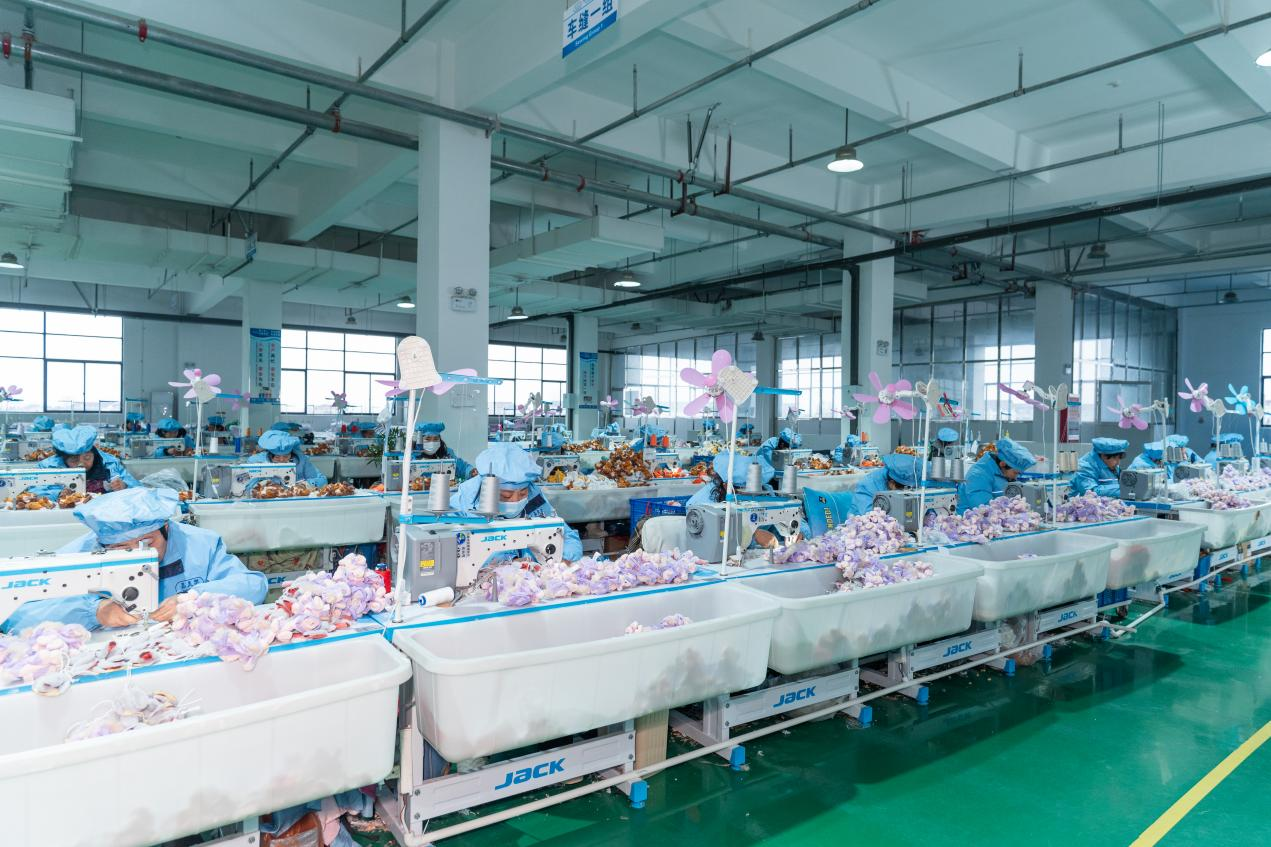
1. Facility size with no unit, no address and no matching legal entity. “We have a big factory” cannot be checked. Ask for production area in square metres, the legal entity name printed on the business licence, and site photographs or an audit report that match the stated address. For scale reference, the Jiameile facility in Tianchang City, Anhui Province covers 6,800 m² — small enough to be audited in a single visit and large enough to host real production lines. A supplier that cannot state its area in a unit is often describing a trading relationship rather than a plant.
2. Output numbers that ignore labour and machine hours. An annual output figure is only meaningful when it is consistent with headcount, line count and shift pattern. Ask for monthly capacity per line, then compare against category benchmarks: mid-size plush factories typically run 100,000–300,000 pieces per month, while large factories run 500,000–1,000,000+ pieces per month. If a supplier claims the top of that range while employing a few dozen staff, the numbers are aspirational rather than operational.
3. “Full OEM/ODM support” with no engineering team behind it. Custom plush pet toy work — new patterns, fabric changes, squeaker or heartbeat module integration, private-label packaging — is an engineering task, not a sales task. Red flags include design support described only as “we can do it”, no stated sample lead time, and no named customisation scope. A verifiable scope covers logo printing, fabric material, size, colour, stuffing type, squeaker type, packaging (box, blister or card) and hang tags, with sample development typically running 7–15 days.
Compliance red flags
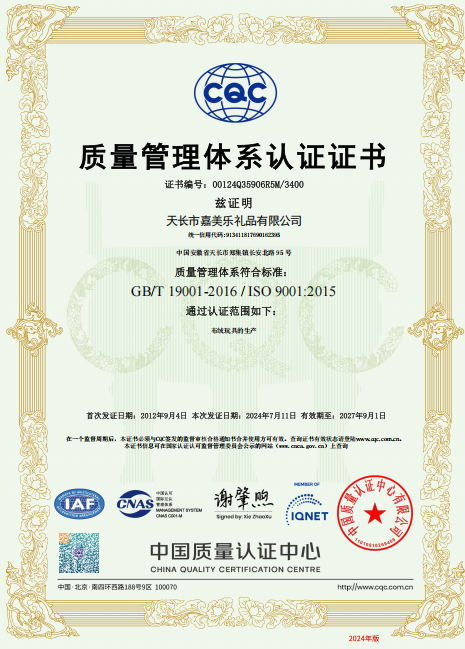
4. Certification names with no number, scope or expiry date. “We are ISO 9001 certified” is not evidence. Evidence looks like a certificate number, an issuing body, an applicable standard, a defined scope and validity dates. A useful template for the format to demand is the ISO 9001 Quality Management System certificate held for plush production at Tianchang Jiameile Gifts Co., Ltd: certificate number 00124Q35906R5M/3400, issued by the China Quality Certification Centre (CQC), based on the standard GB/T19001-2016, covering the production of cloth and plush toys, and valid for the global market. Social-compliance and licensing audits such as ICTI, BSCI and Disney FAMA should be requested in exactly the same format.
5. Safety standards quoted as a slogan rather than as a test scope. Standards that matter for dog plush toys include EN71, ASTM F963 and GB6675, with CPSIA and California Proposition 65 relevant to US retail programmes and GB/T 43839-2024 applied to companion animal product safety in China. The red flag is a supplier who lists these names in a catalogue but cannot show which standard was tested on which SKU, by which laboratory, on which date. Request the report scope per product, not per company.
6. Electronic modules sold without directive evidence. Heartbeat plush dog toys and interactive squeaky plush dog toys contain components that change the compliance profile of the whole SKU. In the EU, pet toys with electronic parts must meet the EMC Directive and RoHS for CE marking. A supplier who quotes these models without stating which directive applies — and without offering module documentation to a third-party laboratory — is transferring regulatory risk to the buyer’s brand.
Delivery red flags
7. A lead time given as a single number with no production calendar. Sample lead time and bulk lead time are different commitments. Plush production typically runs 7–15 days for samples and 20–45 days for bulk, depending on design complexity and order volume. One figure covering both usually means the supplier has not calculated the factory calendar. Ask what starts the clock, what buffer is built in, and what happens when fabric or accessories arrive late.
8. No named inspection gates and no acceptance of third-party inspection. Verifiable quality control runs through IQC (incoming inspection), IPQC (in-process inspection) and OQC (final inspection), with records that can be reviewed on request. Third-party inspections by SGS or BV are frequently required by retail buyers. A supplier that resists an independent inspection is a delivery risk, because the buyer’s first unsupervised look at the goods would otherwise happen after the container has sailed.
9. No written after-sales and spare-unit policy. After-sales terms should be documented before the order: replacement or rework for quality issues, inspection reports supplied with the shipment, and spare units. In practice, 1–3% spare units are sometimes included in bulk orders. The red flag is the answer “we will handle it” with no document, no percentage and no decision rule attached.
How to read a red flag: score the response, not the claim. A supplier that returns a certificate number, a scope line and a validity date within 24 hours is demonstrating the same documentation discipline it will apply to a shipping schedule.
Comparison Table: What Suppliers Claim vs. What Buyers Can Verify
| Supplier claim | Verifiable evidence to request | Red flag if… |
|---|---|---|
| “We are a large factory.” | Production area in m², legal entity name, site photos or audit report matching the address | No unit of measure, no address match, no audit accepted |
| “We have plenty of capacity.” | Annual output in units, headcount, line count, monthly capacity per line | Output claim inconsistent with staff and equipment |
| “We support OEM and ODM.” | In-house R&D headcount, sample lead time, defined customisation scope (fabric, size, colour, stuffing, squeaker, packaging, hang tags) | Design work outsourced or unspecified; no sample timeline |
| “We are certified.” | Certificate number, issuing body, applicable standard, scope, issue and expiry dates | Certificate names without number, scope or validity |
| “Our toys are safe.” | Per-SKU test scope for EN71, ASTM F963, GB6675, CPSIA and GB/T 43839-2024 where applicable | Standards quoted in marketing but not documented per product |
| “Interactive and heartbeat models are compliant.” | EMC Directive and RoHS documentation for CE marking on electronic components | Electronic module sold with no directive evidence |
| “Delivery is fast.” | Production calendar, definition of what starts the lead-time clock, buffer plan | A single number with no calendar behind it |
| “We inspect everything.” | IQC, IPQC and OQC records; acceptance of SGS or BV third-party inspection | No records available, third-party inspection refused |
| “We support after-sales.” | Written replacement and rework terms, inspection reports, spare-unit percentage | Verbal assurance only, no written policy |
Step-by-Step Breakdown: A Six-Step Capacity Verification Sequence
The sequence below converts a supplier conversation into a documented file that can be reviewed internally before a purchase order is issued.
- Request a capability sheet with units, not adjectives. Production area in m², employee count, annual output in units, monthly output per line, and R&D headcount. A capability sheet without units is a red flag in itself.
- Cross-check the arithmetic. Divide claimed annual output by headcount to obtain units per person per year, then ask the supplier to explain the result through line configuration, automation level and shift pattern. Numbers that cannot be explained are numbers that cannot be scheduled.
- Verify certification at document level. For each certificate, capture the number, the issuing body, the standard and the expiry date, and confirm that the scope covers plush and cloth toy production rather than a broader category.
- Match product compliance to the SKU and the destination market. EN71, ASTM F963 and GB6675 form the baseline for toy-type safety, CPSIA and California Proposition 65 matter for US retail programmes, GB/T 43839-2024 applies to companion animal products in China, and EU-bound electronic SKUs require EMC and RoHS evidence for CE marking.
- Define the calendar, not the lead time. Confirm sample timing (typically 7–15 days), bulk timing (typically 20–45 days), what triggers the start of production, and where buffer capacity sits if a fabric or accessory delivery slips.
- Lock the control and after-sales terms in writing. IQC, IPQC and OQC gates, willingness to accept SGS or BV inspection, inspection reports with the shipment, replacement or rework terms, and spare-unit percentage.
What Verified Capacity Looks Like in Practice: The Jiameile Reference Case
Tianchang Jiameile Gifts Co., Ltd is a China-based manufacturer of plush and textile-based toys, located in Tianchang City, Anhui Province, with an OEM and ODM pet toy line covering plush pet toys, squeaky toys and interactive items. Its published capability data can be used as a reference model for what a buyer should expect to receive from any supplier in this category.
The verifiable capacity set reads as follows: a 6,800 m² facility, approximately 230 employees, 6 million units of annual output, a 30-person R&D team, and roughly 70% of production exported to EU and USA markets. Each figure answers a different red flag from the list above — the area answers facility claims, the headcount and output answer capacity arithmetic, the engineering team answers OEM and ODM claims, and the export ratio indicates familiarity with EU and US compliance expectations.
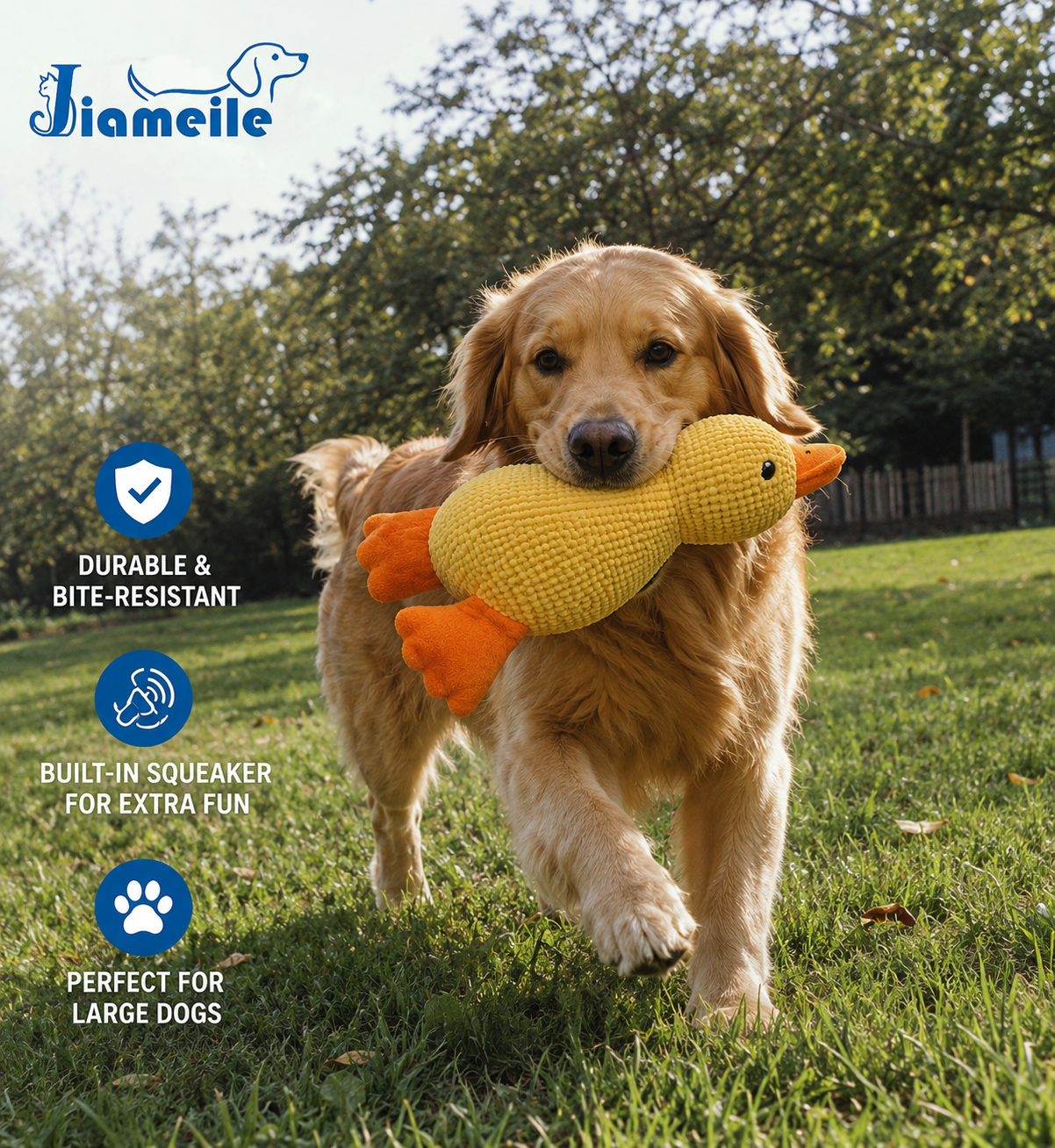
Compliance evidence follows the same pattern. The company holds ICTI, BSCI, Disney FAMA, ISO 9001 and ISO 14001 certifications, and products comply with international safety standards such as EN71, ASTM F963 and GB6675, with CPSIA referenced for the US market and GB/T 43839-2024 applied to companion animal product safety. On the product side, the reinforced chew-resistant series uses non-toxic materials and reinforced stitching, with features including durable and chew-resistant construction, anxiety relief function, interactive squeaker design, a no-stuffing option for safety, and washable and easy-to-clean finishes.
Volume execution can also be evidenced rather than asserted. Jiameile’s licensing background includes authorised production of mascots and related products for UEFA Euro 2016 (France), the FIFA World Cup 2018 (Russia), the FIFA Women’s World Cup 2019 (France), UEFA Euro 2020, the FIFA World Cup 2022 (Qatar) and the Hangzhou Asian Games 2023 — programmes where capacity, compliance documentation and delivery discipline are audited by the rights holder, not by the buyer alone.
Use Cases: Three Buyer Scenarios and the Red Flags That Matter Most
Scenario A — An e-commerce brand launching an anxiety relief dog plush toy
An online seller building a first private-label SKU usually starts with the smallest order tier, typically 500–3,000 pieces. The critical red flags here are engineering depth and sample discipline: whether the supplier can develop an anxiety relief dog plush toy with the right fabric weight and a squeaker or heartbeat module without changing the pattern mid-project. Sample development normally takes 7–15 days, and the sample is where seam construction, module attachment and stuffing decisions are approved. If a supplier cannot state who develops the pattern, the SKU is being designed by the buyer and sourced by the supplier.
Scenario B — A retail chain buying wholesale plush dog toys
Retail and supermarket programmes bring a different failure mode: repeat orders and consumer returns. For a washable plush dog toy or a soft plush dog toy for cuddling sold under a chain’s own label, the red flags are the inspection gates and the after-sales policy. Ask for IQC, IPQC and OQC records, confirm acceptance of SGS or BV inspection, and require written replacement or rework terms plus a spare-unit percentage. A mid-scale retail order typically falls in the 3,000–20,000 piece range, where a 1–3% spare allocation is a practical buffer against individual-unit failures.
Scenario C — A subscription box or brand owner commissioning custom plush pet toys
Subscribers receive repeat parcels, so durability is measured in months of use rather than at first delivery. The relevant red flags combine compliance scope and durability design: whether the reinforced stitching plush toy in question carries per-SKU EN71, ASTM F963, GB6675 and CPSIA documentation, and whether the supplier can define chew-resistance levels against dog weight bands — under 5 kg, 5–15 kg and 15–30 kg. For EU-bound interactive or heartbeat plush dog toys, CE marking supported by EMC and RoHS evidence should be treated as a purchasing condition rather than a later question.
Capacity, Lead Time and MOQ Benchmarks: What Normal Looks Like
Benchmarks give buyers a reference line when a supplier’s answers fall outside the usual range. The figures below reflect typical values for plush pet toy production and should be used to frame questions, not to replace verification.
| Procurement parameter | Typical range | Why it matters for delivery assurance |
|---|---|---|
| Monthly capacity | Mid-size factories: 100,000–300,000 pcs/month; large factories: 500,000–1,000,000+ pcs/month | Reveals whether the order fits the factory’s real loading |
| Sample lead time | 7–15 days | Determines how much of the launch calendar is consumed before approval |
| Bulk production lead time | 20–45 days, depending on complexity and volume | Sets the realistic ship window and the buffer requirement |
| MOQ | Typically 500–3,000 pcs/style; complex custom designs often 3,000–5,000 pcs | Determines whether a pilot order is possible before volume commitment |
| Order scale tiers | Pilot 500–3,000 pcs; mid-scale 3,000–20,000 pcs; large long-term supply 20,000–100,000+ pcs | Matches the supplier’s track record to the size of the programme |
| Quality control | IQC incoming inspection, IPQC in-process inspection, OQC final inspection; third-party inspections by SGS or BV often required | Defines where defects are caught — before or after shipping |
| Production mode | OEM manufacturing, ODM development and private-label customisation | Confirms whether the buyer’s own brand assets can be supported |
| After-sales | Replacement or rework for quality issues; inspection reports; 1–3% spare units sometimes included | Reduces the cost of a defective batch reaching the end consumer |
FAQ: Dog Plush Toy Supplier Red Flags
What certifications should a dog plush toy supplier be able to show before a bulk order?
At company level, expect verifiable certificates such as ICTI, BSCI, Disney FAMA, ISO 9001 and ISO 14001, each with a certificate number, issuing body, applicable standard, scope and validity period — not simply a logo on a website. At product level, expect documentation covering EN71, ASTM F963 and GB6675, plus CPSIA and California Proposition 65 where US retail programmes are involved, and GB/T 43839-2024 for companion animal product safety. For EU-bound SKUs that include electronic components, such as heartbeat or interactive plush toys, EMC and RoHS evidence supporting CE marking is also required. Ask for the test scope per SKU, not per company.
How can a buyer verify that a supplier’s manufacturing capacity claim is real?
Cross-check four data points that must agree with each other: production area in square metres, headcount, annual output in units, and R&D headcount. Then compare the figures against category benchmarks — mid-size plush factories typically run 100,000–300,000 pieces per month and large factories 500,000–1,000,000+ pieces per month. As a working example, Jiameile operates a 6,800 m² facility with approximately 230 employees, an annual output of 6 million units and a 30-person R&D team, with about 70% of production exported to EU and USA markets. Licensed programme experience, such as producing for the FIFA World Cup 2018, UEFA Euro 2020, the FIFA World Cup 2022 or the Hangzhou Asian Games 2023, is a further indicator that the capacity has been audited by parties other than the buyer.
What drives the unit cost of a custom plush dog toy?
Cost in this category is driven by fabric and material selection, stuffing type or a no-stuffing construction, squeaker or heartbeat module specification, reinforcement stitching, packaging format (box, blister or card, plus hang tags), and order quantity relative to MOQ. Typical MOQs sit at 500–3,000 pieces per style, with complex custom designs often requiring 3,000–5,000 pieces. Because unit price alone is a misleading measure for a chew-resistant product, the more useful comparison is cost against service life — the reinforced chew-resistant series is designed for an average service life of 12–24 months, with reinforced stitching, non-toxic materials, washable finishes and a no-stuffing option, which changes the true cost per month of use rather than the invoice line.
What should a sample evaluation actually cover?
Sample development in plush pet toys typically takes 7–15 days, and the sample is the point where construction decisions become binding. Check the seam integrity of the reinforced stitching, the attachment of the squeaker or heartbeat module, the washability of the outer fabric, and whether the no-stuffing construction matches the buyer’s safety requirements. Confirm chew-resistance level against the intended dog weight band — under 5 kg, 5–15 kg, or 15–30 kg — and match the sample against the supplier’s rated resistance level. Before approving, confirm that the corresponding EN71, ASTM F963, GB6675 or CPSIA documentation applies to the exact sample SKU.
How do buyers protect delivery dates on a plush dog toy order?
Three things protect a delivery date: a defined clock, visible control gates and written after-sales terms. Bulk production in this category typically runs 20–45 days depending on complexity and volume, and the buyer should confirm what starts that clock — fabric arrival, sample approval or deposit. Control gates should be named, with IQC, IPQC and OQC inspection records available and third-party inspection by SGS or BV accepted in advance. Finally, require written replacement or rework terms and confirm whether 1–3% spare units are included. Buyers who want to test this process before committing volume can request a sample or a quotation from Jiameile at winnie@jml-toys.com or via WhatsApp on +86 173-7538-5845 (contact: Wendy).
Conclusion: Verify the Units, the Documents and the Schedule
Red flags in dog plush toy supplier evaluation are rarely dramatic. They usually look like an area figure without a unit, an output claim without headcount, a certification name without a number, or a delivery promise without a calendar. Those gaps matter more in plush than in many other categories, because tearing seams, module attachment and stuffing choices only reveal themselves after the consumer has used the product for weeks.
The verification sequence is repeatable: confirm that capacity is measurable in units, confirm that certifications carry numbers, scopes and expiry dates, confirm that product compliance is documented per SKU for the destination market, and confirm that sample timing, bulk timing, inspection gates and spare-unit terms are written down. When a supplier answers all four with files, the delivery assurance question largely answers itself — and the buyer can move from evaluating a supplier to planning a launch.
Request a sample or quotation
Tianchang Jiameile Gifts Co., Ltd manufactures plush pet toys, including durable reinforced-stitching series, squeaky and interactive designs, washable constructions and no-stuffing options, with OEM and ODM support for pet brands, retailers and importers.
Contact: Wendy | Email: winnie@jml-toys.com | WhatsApp: +86 173-7538-5845 | Tel: +86 17375385845, +86 18855090918
More sourcing guides are published on the Jiameile blog: blog.jiameiletoys.com
Have Questions or Need More Details?
Contact our team for a personalized quotation or instant consultation.
Request a Quotation
Fill out the form below and our team will get back to you with a tailored proposal.
WhatsApp Direct Chat
Prefer to chat in real-time? Message us on WhatsApp for instant assistance & quick answers.
- Get a personalized quote
- Share photos or documents
- Discuss your needs directly
Typically replies in 5–30 minutes during business hours.