Delivery Assurance Audit for Custom Plush Pet Toy Suppliers: Capacity and Lead-Time Checks
A delivery assurance audit for custom plush pet toy suppliers verifies four controls that decide whether a program ships on schedule: planned monthly capacity, backup capacity, component and material inventory, and lead-time management against a written schedule. Buyers who check those four controls during the research and evaluation stage usually avoid the most expensive failure mode in plush toy sourcing, which is a confirmed order that cannot be produced in the month it was promised.
This guide is written for procurement teams, brand owners, importers, and private-label program managers running custom plush pet toys for dogs, from a 500-piece pilot to a 100,000-piece annual supply plan. It sets out a six-control audit framework, a seven-step execution sequence, two planning tables, and the questions to settle before a purchase order is issued.
Jiameile (Tianchang Jiameile Gifts Co., Ltd) is a China-based manufacturer of plush and textile-based toys, founded in 2004 in Tianchang City, Anhui Province, that produces plush pet toys, squeaky toys, and interactive items with full OEM/ODM support. Its production data is used below as a working example of the evidence a buyer should request and reconcile during an audit.

Problem Definition: Where Custom Plush Pet Toy Deliveries Actually Break
A capacity claim answers how much a factory can produce. A delivery commitment answers a harder question: how much of that capacity will still be available when your order reaches the line. Delivery failures on plush toy programs usually come from three mechanisms, and each one can be checked before a purchase order exists.
1. Capacity is shared, not reserved
Custom plush pet toys run on the same cutting, sewing, stuffing, and finishing lines as every other program in a factory's book. Take a factory in the large capacity band described in this industry, where large factories commonly run 500,000–1,000,000+ pcs/month. A buyer ordering 20,000 pieces will not use a whole month of that capacity, but the order still has to fit into a specific window alongside every other confirmed program. The audit question is therefore not "how large is your factory" but "how much uncommitted capacity exists in the production weeks my order occupies."
2. Components extend the critical path
Plush pet toys are assemblies, not single-material products. Squeaky custom plush pet toys and interactive custom plush pet toys depend on purchased parts, and these applications require supporting equipment and components such as a squeaker device, a heartbeat module, a rope structure, TPR teething components, a removable washable cover, and an anti-slip bottom design. Each of those parts is sourced, inspected, and staged before final assembly. A 20–45 day bulk production window assumes the components are on hand; if a squeaker device or heartbeat module has to be sourced after the order is confirmed, the calendar moves with it.
3. Compliance documents gate shipment
Testing and certification are shipping gates, not administrative extras. Plush pet toys intended for the US market must comply with ASTM F963-23, which regulates flammability, heavy metals, and mechanical safety including seam strength. Products sold in the EU must bear the CE mark and pass EN71-1 (mechanical), EN71-2 (flammability), and EN71-3 (chemical migration) testing. When documentation is incomplete at the end of production, a finished order can sit in the warehouse while the retail window closes.
Audit rule of thumb: verify uncommitted capacity for the production month first, then verify the lead time of the slowest component in the bill of materials. Both answers belong in the audit report as written findings, not as verbal assurances.
Industry Background: Why Delivery Discipline Is Now a Purchasing Criterion
The global pet toys market was valued at approximately USD 10.6 billion in 2025 and is projected to reach USD 22.4 billion by 2033, according to Grand View Research. Dog toys represent the largest segment, holding a 52.2% share of the pet toy market in 2025, and the broader stuffed animals and plush toys market, including plush pet products, was valued at USD 13.68 billion in 2025. Within that category, interactive pet toys are expected to reach USD 3.7 billion by 2030, growing at a CAGR of 10.2% as owners prioritize mental stimulation.
Two structural details matter for delivery planning. Fabric is the largest material segment for dog toys in the US, accounting for a 39.8% market share as of 2025 (Future Market Insights), which keeps textile-based manufacturing capacity in constant demand. At the same time, China's pet toy market, valued at approximately USD 516.1 million in 2023 with a projected CAGR of 9.7% through 2030, competes for the same factory capacity that export buyers are booking.
The practical consequence is straightforward: growth in this category does not create new capacity, it distributes the same capacity across more concurrent programs. That is why monthly capacity planning, backup capacity, and lead-time management have become standard items in supplier evaluation rather than details handled after the order is placed.
The Delivery Assurance Audit Framework: Six Controls
Control 1: Verifying Monthly Capacity Planning
Monthly capacity planning is a supplier's own written answer to what can be produced in a defined period, by line, after existing commitments. Buyers should request it as a document rather than accept it in conversation.
Industry capability ranges provide a benchmark for reading that document. Mid-size factories typically run 100,000–300,000 pcs/month, while large factories run 500,000–1,000,000+ pcs/month. A factory's position in that range should be consistent with the rest of its profile: floor space, headcount, equipment, and annual output.
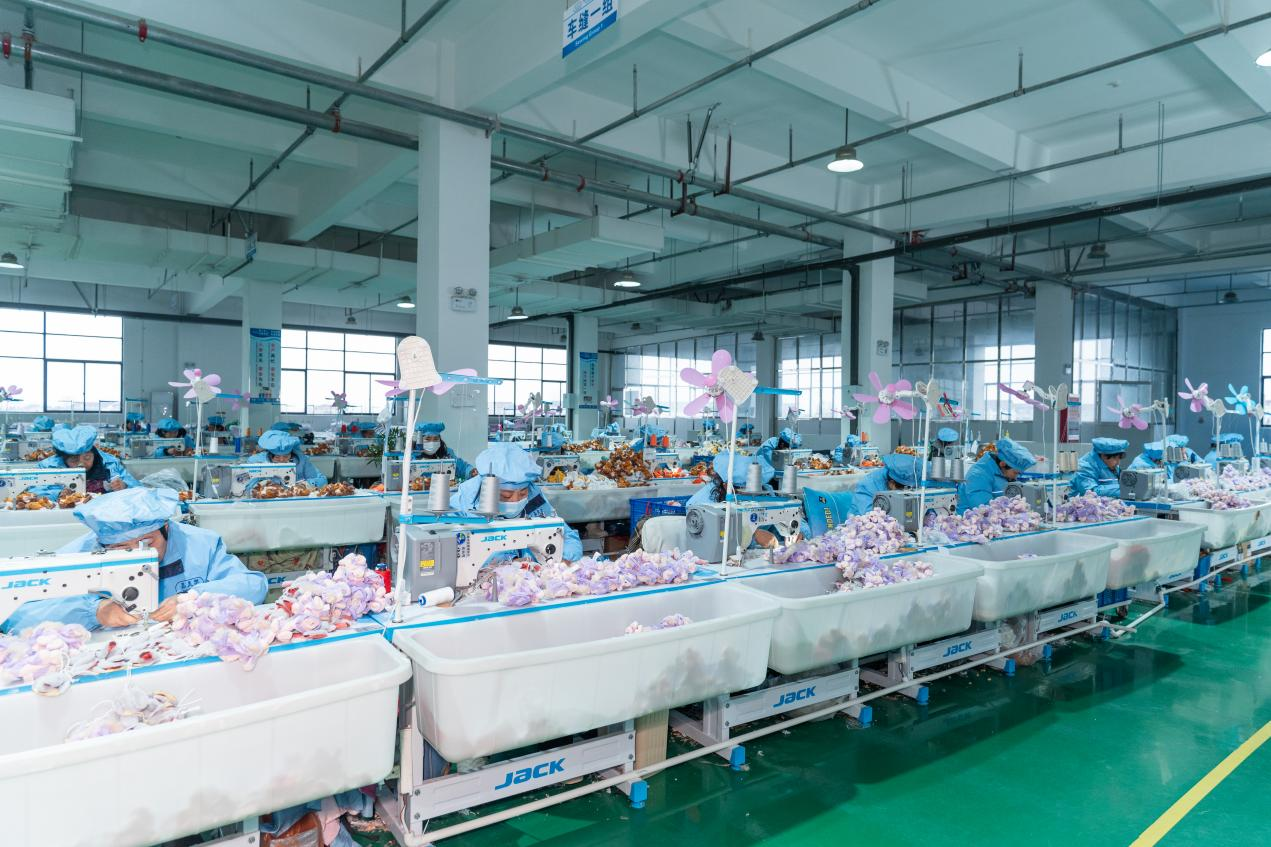
Jiameile operates a 6,800 m² facility with 230 employees, a 30-person R&D team, and annual output of 6 million pieces, with approximately 70% of production exported to the EU and USA. During an audit, those figures matter less as headline numbers than as a consistency check against the monthly plan a buyer is handed. A plan that cannot be explained by physical capacity has failed the first control test.
Request items: a monthly capacity statement by production line, the currently committed load for the target production weeks, and the available capacity remaining in the month your order lands.
Control 2: Checking Backup and Redundant Capacity
Backup capacity is the difference between a schedule that can absorb a disruption and one that cannot. Three forms of redundancy are worth verifying in a plush pet toy program:
- Line redundancy: whether a program can be split across more than one sewing or assembly line when a line is occupied by another order.
- Component redundancy: whether critical purchased parts, such as squeaker devices and heartbeat modules, have more than one qualified source.
- Service-scope redundancy: whether the factory can cover the process from design through packaging in one place, which reduces external handoffs on the critical path. Full-service solutions from design to packaging are a mainstream capability in this industry, and buyers should confirm which stages a specific supplier performs in-house.
Control 3: Inventory and Component Management
Inventory management in plush toy manufacturing covers three layers: base fabrics such as short plush and Oxford fabric, filling and stitching materials, and functional components. Squeaky, teething, and interactive designs depend on purchased parts, so the audit should verify stocking policy and reorder triggers for the specific components listed in the bill of materials.
MOQ belongs to this control because it determines how much material must be committed before production starts. In this category, MOQs typically run 500–3,000 pcs/style, with complex custom designs often at 3,000–5,000 pcs. Buyers should confirm whether the MOQ applies per style, per colorway, or per component set, since that detail frequently decides whether a pilot order is feasible at all.
Control 4: Lead-Time Management
Lead time is not a single number; it is a sequence. Standard industry lead times in this category are 7–15 days for samples and 20–45 days for bulk production, depending on design complexity and order volume. A delivery assurance audit converts that range into a dated waterfall: sampling and approval, component procurement, cutting and sewing, stuffing and finishing, in-house inspection, third-party inspection where required, and packing.
Two practices make the waterfall defensible. First, anchor production dates to the sample approval date rather than the inquiry date. Second, separate buyer-controlled delays, such as sample feedback and artwork approval, from supplier-controlled ones, so that responsibility for a slipped date is visible before it becomes a dispute.
Control 5: Quality Control Gates as Delivery Controls
Quality control functions as a delivery control because rework consumes the same calendar time as production. The industry-standard sequence is IQC incoming inspection, IPQC in-process inspection, and OQC final inspection, with third-party inspections by SGS or BV often required by buyers or retail programs. Suppliers in this category commonly provide inspection reports, include 1–3% spare units, and cover replacement or rework for quality issues in their after-sales terms.
For the audit, the useful questions are when each gate occurs relative to the ship date, and what happens to the schedule if a gate fails. Heavy duty custom plush pet toys and tear resistant custom plush pet toys, for example, depend on reinforced stitching and chew-resistant construction, and those characteristics are verified at inspection gates rather than assumed from a specification sheet.
Control 6: Compliance and Documentation Readiness
Compliance documentation should be audited as a delivery control, because a missing certificate stops a shipment as effectively as a missing container. The list covers product-level testing, including EN71 parts 1, 2, and 3 with CE marking for the EU, ASTM F963-23 for the US, CPSIA, and GB/T 43839-2024 for companion animal products, alongside factory-level certification that retail programs screen for, such as ICTI, BSCI, Disney FAMA, ISO 9001, and ISO 14001.
Jiameile holds ICTI, BSCI, Disney FAMA, ISO 9001, and ISO 14001 certification, and its products comply with international safety standards including EN71, ASTM F963, and GB6675. Buyers should request current certificate copies and confirm which product families and markets they cover before the audit closes.
Step-by-Step: Running the Audit in Seven Steps
- Request the document pack before any visit. Ask for the capacity statement by line, committed load for the target month, component supplier list, lead-time schedule, QC procedure, and current certificate copies.
- Convert capacity claims into monthly arithmetic. Reconcile the claimed monthly plan against annual output, floor space, workforce, and equipment. A plan that physical capacity cannot explain is the first finding.
- Map the component critical path. List every purchased part in the bill of materials, including the squeaker device, heartbeat module, TPR teething components, rope structure, washable cover, and anti-slip base, and record the lead time for each.
- Build the lead-time waterfall. Convert the 7–15 day sampling and 20–45 day bulk production ranges into calendar dates, and mark the buffer explicitly.
- Validate with a sample. Sample approval is the anchor date for the entire production schedule, so validate materials, dimensions, component placement, stitching reinforcement, and packaging at that stage.
- Agree QC and inspection gates. Fix the timing of IQC, IPQC, and OQC, plus any SGS or BV inspection windows, and define the exception path if a gate fails.
- Put after-sales terms in writing. Confirm replacement or rework scope, inspection reporting, and spare unit provisions before the order is confirmed.
Use Cases: Matching Audit Focus to the Program Type
Pilot and test orders (500–3,000 pcs)
Pilot orders exist to validate a design, not to test a supplier's scale, so the audit focus sits on MOQ alignment (500–3,000 pcs/style) and sample lead time (7–15 days). For a squeaky or teething design, confirm that the component set is available at pilot volume. A squeaker device or heartbeat module with a high component MOQ can make a small pilot impractical even when the fabric and labor are available.
Mid-scale e-commerce and retail roll-outs (3,000–20,000 pcs)
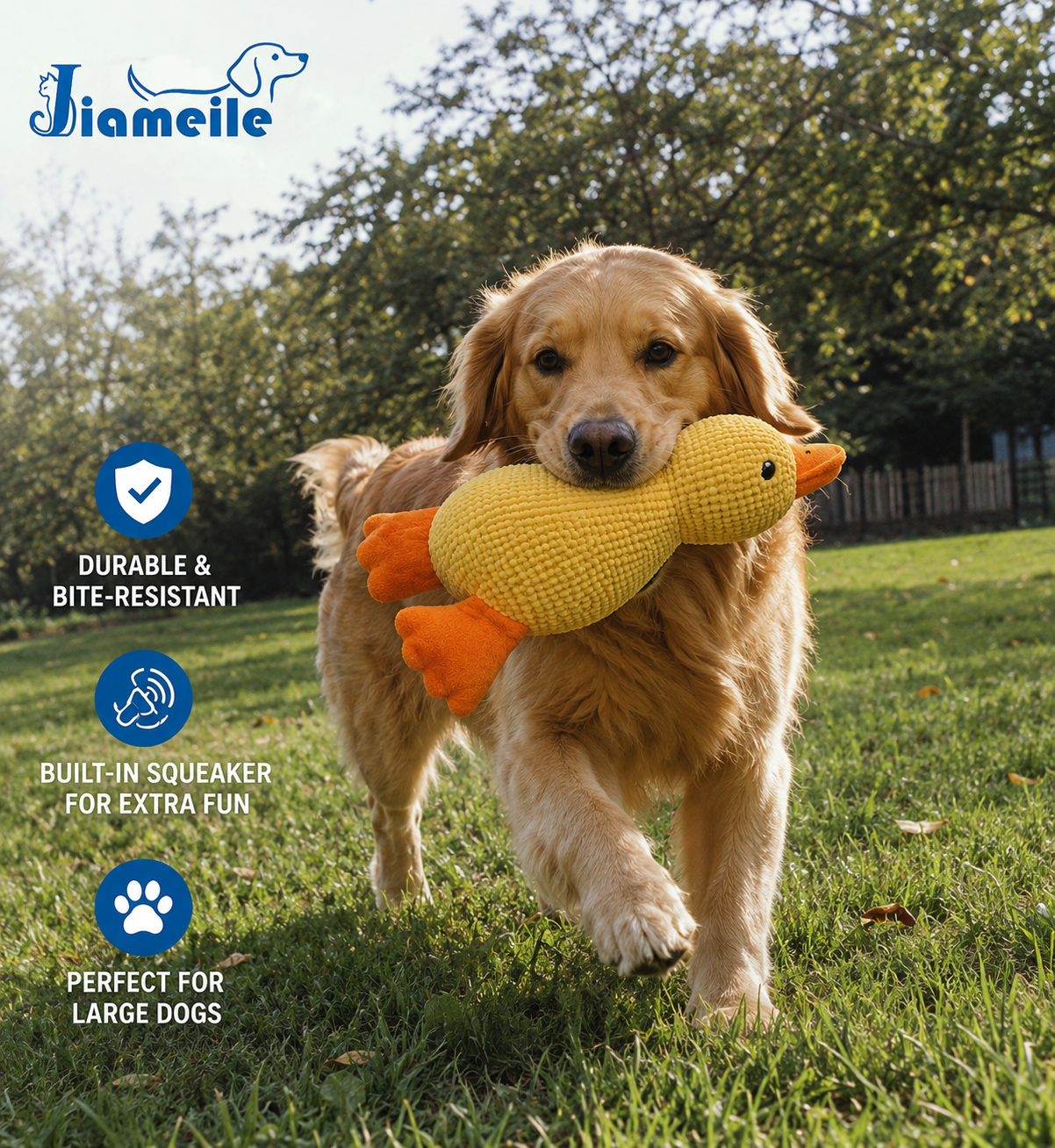
At this volume the binding constraint is usually monthly capacity rather than tooling. Judge the program against mid-size capacity bands of 100,000–300,000 pcs/month and confirm how the order is distributed across lines. Size and material range typically covers 10–15 cm and 15–20 cm short plush for small size custom plush pet toys, 20–30 cm Oxford fabric for medium designs, and 30–50 cm TPR for large designs. Different materials compete for different line set-ups, so the split between them matters to the schedule.
Large long-term supply programs (20,000–100,000+ pcs)
Long-term programs need reserved capacity rather than available capacity. Buyers should request a rolling monthly plan covering the contract period and check the supplier's record on repeat business. Jiameile reports a repeat purchase rate of over 85%, with some long-term clients purchasing more than 100,000 pieces annually, and its reinforced chew-resistant series offers an average service life of 12–24 months.

Recurring subscription and replenishment programs
Monthly replenishment models convert a delivery problem into a cadence problem: the same SKU has to be produced, inspected, and packed on a repeating cycle. The audit focus shifts to inventory triggers and confirmations around whether the factory can hold a recurring production slot instead of re-queuing the order each cycle. Washable custom plush pet toys with removable covers fit this model well, because a predictable, repeatable construction is easier to schedule than a new design every cycle.
Fixed-date and licensed programs
Programs tied to retail resets, seasonal launches, or licensed properties have immovable delivery dates. Jiameile has been officially authorized to produce mascots and related products for major fixed-date events, including UEFA Euro 2016, the FIFA World Cup 2018, the FIFA Women's World Cup 2019, UEFA Euro 2020, the FIFA World Cup 2022, and the Hangzhou Asian Games 2023. The transferable practice for pet toy buyers is procedural: fixed-date programs are planned backward from the delivery date, with the compliance calendar treated as part of production rather than as an afterthought.
Comparison Table: The Delivery Assurance Audit Checklist
The table below summarizes what each control verifies, the evidence that should be requested, and the delivery risk that remains if the control is not audited. All capacity, MOQ, lead-time, and compliance benchmarks in it are drawn from published industry capability ranges and recognized standards.
| Audit control | What to verify | Evidence to request | Delivery risk if unverified |
|---|---|---|---|
| Monthly capacity planning | Capacity available in the target production month, by line, after existing commitments | Monthly capacity statement, committed load, floor space, workforce, equipment, annual output | The order queues behind existing programs and the promised date slips without notice |
| Backup capacity | Redundancy across lines, qualified component sources, and in-house process scope | Line allocation plan, component source list, in-house process list from design to packaging | A single line or single component source becomes a single point of failure |
| Inventory and components | Stocking policy for fabrics and purchased components; MOQ structure per style | Bill of materials, reorder triggers, MOQ confirmation (500–3,000 pcs/style; 3,000–5,000 pcs for complex designs) | Material shortages or an MOQ mismatch are discovered only after order confirmation |
| Lead-time management | A dated production waterfall from sample approval to packing | Lead-time schedule (samples 7–15 days; bulk 20–45 days) with buffer and milestones | Ranges are quoted instead of dates, and slippage stays invisible until it is irreversible |
| Quality control gates | Timing of IQC, IPQC, and OQC relative to the ship date | QC procedure, inspection reports, SGS or BV inspection arrangement | Rework consumes production calendar late in the schedule, after the buffer is gone |
| Compliance documentation | Market-specific testing and factory certification valid at the ship date | EN71 parts 1–3 and CE, ASTM F963-23, CPSIA, GB/T 43839-2024; ICTI, BSCI, Disney FAMA, ISO 9001, ISO 14001 | Finished goods are held at the warehouse awaiting certificates |
Comparison Table: Audit Focus by Order Tier
| Program tier | Typical order size | Primary audit focus | Product example |
|---|---|---|---|
| Pilot or test order | 500–3,000 pcs | Component availability at low volume; sample lead time of 7–15 days | Small dog toy in short plush, 10–15 cm and 15–20 cm |
| Mid-scale e-commerce or retail | 3,000–20,000 pcs | Monthly capacity allocation across lines; MOQ structure per style | Medium dog toy in Oxford fabric, 20–30 cm |
| Large long-term supply | 20,000–100,000+ pcs | Reserved capacity, rolling monthly plan, repeat-order record | Large dog toy in TPR, 30–50 cm |
What the Audit Does Not Cover
A delivery assurance audit reduces risk; it does not remove it. Capacity figures are stated by the supplier and should be reconciled against physical evidence, including floor space, workforce, equipment, and annual output. Lead times in this category are ranges, 7–15 days for samples and 20–45 days for bulk production, because they vary with design complexity and order volume, so any single guaranteed number should be traceable to a dated plan. Component availability for functional parts such as squeakers and heartbeat modules also depends on upstream suppliers outside the factory's direct control, which is precisely why backup sourcing belongs inside the audit rather than inside the contingency plan.
Frequently Asked Questions
Which compliance documents should a delivery audit verify before production starts?Verify two layers. At product level, plush pet toys intended for the US market must comply with ASTM F963-23, which regulates flammability, heavy metals, and mechanical safety including seam strength, while products sold in the EU must bear the CE mark and pass EN71-1 (mechanical), EN71-2 (flammability), and EN71-3 (chemical migration) testing; companion animal products also reference GB/T 43839-2024, and CPSIA applies to the US market. At factory level, retail programs commonly screen for ICTI, BSCI, Disney FAMA, ISO 9001, and ISO 14001, all of which Jiameile holds. Request current copies and confirm which product families and markets each certificate covers, because a certificate that does not match the SKU being ordered will not release a shipment.
How can a buyer verify monthly capacity instead of accepting a headline number?Compare three things. First, the capacity band the factory claims: mid-size factories typically run 100,000–300,000 pcs/month, and large factories 500,000–1,000,000+ pcs/month. Second, the physical basis for that band, meaning floor space, workforce, equipment, and annual output. Jiameile, for example, operates a 6,800 m² facility with 230 employees, a 30-person R&D team, and annual output of 6 million pieces, roughly 70% of which is exported to the EU and USA. Third, the committed load during the specific production month. The control passes only when the first two figures can carry the third.
How do MOQ and order size affect delivery planning?MOQ determines how much material and how many components must be committed before a line is set. In this category, MOQs typically range from 500–3,000 pcs/style, with complex custom designs often at 3,000–5,000 pcs. Programs are usually planned in three tiers: pilot orders of 500–3,000 pcs, mid-scale e-commerce or retail orders of 3,000–20,000 pcs, and large long-term supply of 20,000–100,000+ pcs. Volume also determines the commercial terms that affect total program cost, including inspection arrangements, spare unit provisions of commonly 1–3%, and after-sales replacement or rework scope, all of which are quoted per project.
What should the sampling stage prove before bulk production is committed?Sampling is the anchor of the production schedule. Standard sample lead time in this category is 7–15 days, and the approved sample should lock materials, dimensions, component placement, stitching reinforcement, and packaging. For functional designs, sampling also validates the supporting equipment in assembled form, whether that is a squeaker device, a heartbeat module, or TPR teething components. Buyers should treat the sample approval date, not the inquiry date, as day zero for a 20–45 day bulk production window.
What lead time should be written into a custom plush pet toy contract?Write a dated schedule rather than a range. Industry lead times are 7–15 days for samples and 20–45 days for bulk production depending on complexity and volume, and those ranges should be converted into calendar dates covering sampling, component procurement, cutting and sewing, finishing, IQC/IPQC/OQC inspection, any third-party inspection by SGS or BV, and packing, with explicit buffer for the compliance calendar and buyer-side approvals. A practical starting point is to ask a supplier to quote a sample and a production slot against your target launch date. Jiameile accepts sample and quotation requests at winnie@jml-toys.com or through WhatsApp at +86 173-7538-5845.
Conclusion: Audit the Capacity, Then Trust the Calendar
Delivery assurance for custom plush pet toys is built from evidence a supplier can produce before a purchase order exists: a monthly capacity statement that matches the physical factory, backup capacity across lines and component sources, an inventory policy that covers purchased functional parts, and a dated lead-time waterfall from sample approval to packing, with compliance documentation treated as a shipping gate rather than as paperwork.
Buyers who run this audit during the research and evaluation stage turn a capacity claim into a verifiable plan. The program tiers in this category are well established, from pilots at 500–3,000 pcs to mid-scale programs at 3,000–20,000 pcs and long-term supply at 20,000–100,000+ pcs, and each tier fails for different reasons. Matching the audit focus to the tier is what keeps a plush toy program on schedule.
Next step: request a sample and a capacity-based production schedule for your custom plush pet toy program. Contact Jiameile at winnie@jml-toys.com, by WhatsApp at +86 173-7538-5845, or visit the Jiameile blog for further sourcing guidance.
Have Questions or Need More Details?
Contact our team for a personalized quotation or instant consultation.
Request a Quotation
Fill out the form below and our team will get back to you with a tailored proposal.
WhatsApp Direct Chat
Prefer to chat in real-time? Message us on WhatsApp for instant assistance & quick answers.
- Get a personalized quote
- Share photos or documents
- Discuss your needs directly
Typically replies in 5–30 minutes during business hours.