After the Order: A Long-Term Dog Plush Toy Partnership and Support FAQ
What actually happens after a purchase order for dog plush toys is confirmed — production control, acceptance criteria, certification paperwork, reorders and after-sales handling — is where long-term supply relationships are won or lost. This FAQ answers the post-order questions long-term buyers most often raise, using verified facts about Tianchang Jiameile Gifts Co., Ltd. (Jiameile), a plush and textile-based toy manufacturer established in 2004 in Tianchang City, Anhui Province, China.
Most sourcing guides stop at supplier selection. In practice, buyers who reorder dog plush toys across several seasons care about a different set of questions: who signs off on the golden sample, which inspection records travel with the shipment, what happens when a batch fails final inspection, how quickly a repeat order can be scheduled, and how long a product is expected to stay in service in the end customer's home. This article handles those questions in the order a buyer encounters them: after the order, during production, at acceptance, and across the following 12 to 24 months of partnership.
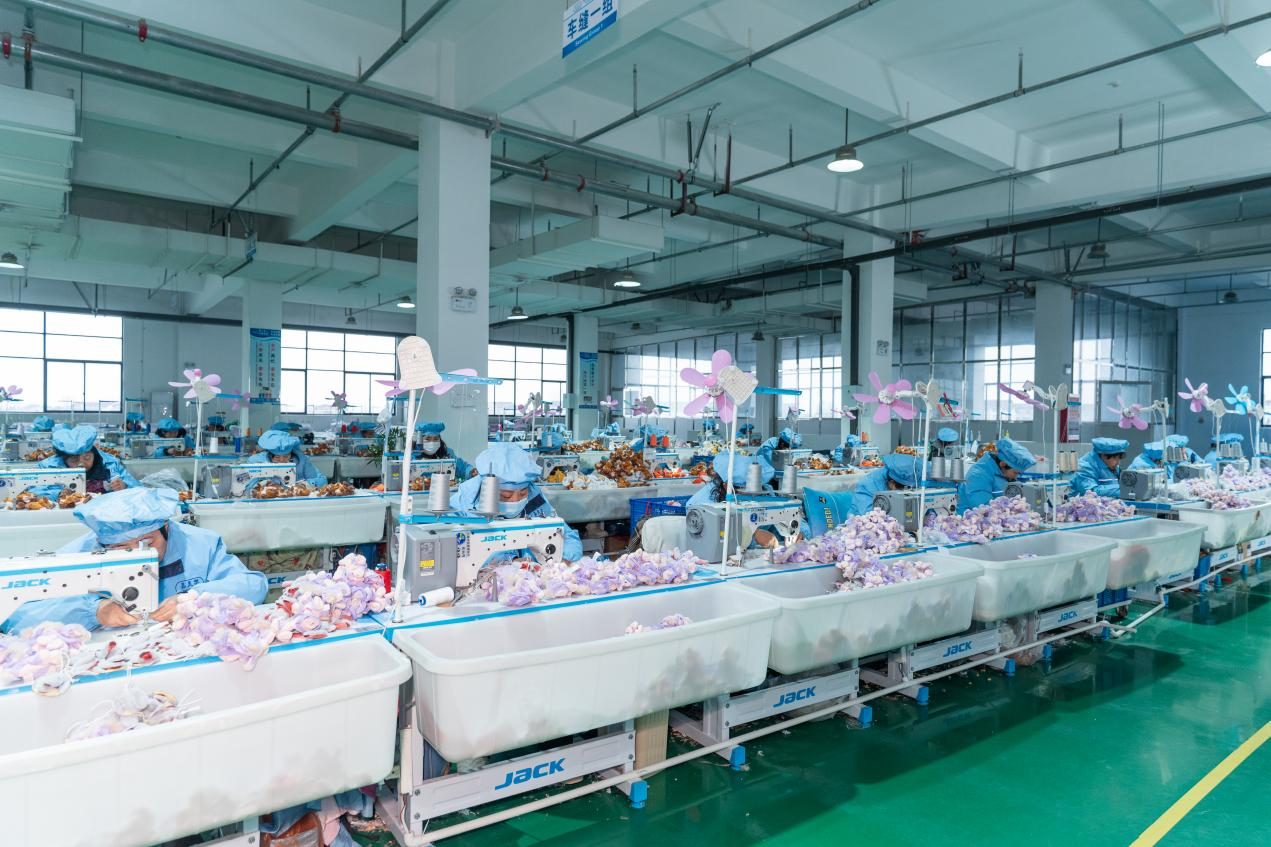
Jiameile factory — plush and textile-based toy production supporting OEM, ODM and private label dog plush toy programmes.
1. The Post-Order Gap: Where Dog Plush Toy Partnerships Actually Fail
The post-order gap is the distance between an approved specification sheet and the cartons that arrive at the buyer's warehouse. It is not a commercial problem — price and MOQ are already settled by then — but an operational one, and it usually appears in five predictable places.
- Specification drift. Fabric weight, stuffing density, squeaker type, stitch pattern or hang-tag artwork changes between sampling and bulk production without a written change record.
- Acceptance ambiguity. Neither side has defined what “pass” means, so a defect discussion starts only after inspection results arrive.
- Certification timing. Test reports and certificates reach the buyer after the retail listing or customs document deadline, holding up the shipment.
- Mismatch between chew level and service life. A product built for a light chewer is sold into a household with an aggressive chewer, and the return rate rises for reasons that look like a quality failure but are actually a specification failure.
- Replenishment friction. A repeat order is treated as a new project rather than a continuation, so tooling, artwork and approved samples have to be reconstructed.
Each of these is a process question, not a capability question, and each can be answered in writing before the first carton is packed. That is the logic behind a structured post-order support model: define the terms, define the acceptance criteria, define the documentation set, and define what happens when something goes wrong.
2. Industry Background: What Buyers Now Expect After the PO
Commercial Market Insights values the global dog toys market at USD 4.16 billion in 2025 and projects an 8.51% CAGR from 2025 to 2034 (source: Custom Market Insights, Dog Toys Market Size, Trends, Share 2025–2034). A market of that scale, growing at that rate, produces more SKUs, more private label programmes and more repeat purchasing — and with them, more post-order scrutiny.
Three expectations have become standard for buyers placing dog plush toy orders into North America and Europe:
Safety evidence is requested twice — once at supplier qualification, once again at shipment.
The relevant frameworks are well established. EN71 governs toy safety in the EU; ASTM F963 and CPSIA govern the US market; GB6675 is the Chinese national toy safety standard; and GB/T 43839-2024, “Safety Technical Requirements for Companion Animal (Pet) Products”, is the reference standard cited for pet toy specifications. Stuffed animal toys are classified under HS code 9503.00.41 for customs purposes. Jiameile products comply with EN71, ASTM F963 and GB6675, and its pet toy lines cite GB/T 43839-2024 as the applicable safety standard.
Order terms are expected to be documented, not negotiated per shipment.
MOQ bands, payment structure, delivery terms, inspection responsibilities and after-sales handling are now reviewed as part of supplier evaluation, because a buyer who discovers these details only after a dispute has already lost the negotiation.
Service life is expected to match the chew level the product is sold for.
Selling a plush toy into a multi-dog household without an honest statement of expected service life creates returns that no inspection process can prevent. Buyers increasingly want the expected service life written on the specification, not discovered through complaints.
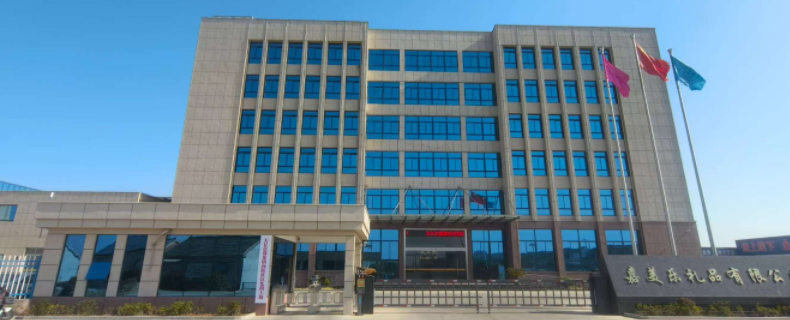
Company real-scene photo — Jiameile operates a 6,800 m² facility with approximately 230 staff and a 30-person R&D team.
3. How Jiameile Structures Support After the Order
Tianchang Jiameile Gifts Co., Ltd. — trading as Jiameile — is a professional manufacturer integrating R&D, production and international trade in plush and textile-based toys, including plush toys, gift items, pet toys, baby toys and rocking horses, with high-end customization for international IPs and full OEM/ODM support. Founded in 2004, the company operates a 6,800 m² facility with approximately 230 employees and a 30-person R&D team, producing 6 million units annually — roughly 500,000 pieces per month — with around 70% of output exported to EU and US markets.
Its certification set covers the audits buyers typically ask for at contract stage: ICTI, BSCI, Disney FAMA, ISO 9001 and ISO 14001. The ISO 9001 quality management system certificate (No. 00124Q35906R5M/3400) is issued by CQC against GB/T19001-2016, with the scope “Production of cloth/plush toys”, issued on 11 July 2024 and valid until 1 September 2027.
3.1 Order terms that do not move after signature
OEM manufacturing, ODM development and private label customization are all standard production modes. Minimum order quantity is typically 500–3,000 pieces per style, rising to 3,000–5,000 pieces for complex custom designs. Delivery terms are mainly FOB, followed by EXW, with CIF or DDP available for cross-border e-commerce buyers. Payment follows the standard industry structure of 30% deposit with the 70% balance before shipment. Listing these terms once, in the contract, removes the single most common source of friction in a second or third order.
3.2 Acceptance criteria agreed before production starts
Quality control runs through three stages: incoming inspection (IQC), in-process inspection (IPQC) and final inspection (OQC) before shipment. Third-party inspection by agencies such as SGS or BV is frequently required and can be scheduled into the production plan. Acceptance is therefore not a single event at the end of the line — it is a sequence with a defined owner at each stage.
3.3 Customization scope that can be re-ordered
Customization covers logo printing, fabric material, size, colour, stuffing type, squeaker type, packaging (box, blister or card) and hang tags. Because each of these variables is recorded on the approved sample and specification, a repeat order can be rebuilt from the record rather than re-briefed from memory. Construction choices also include reinforced stitching, no-stuffing designs for safety, and washable finishes.
3.4 After-sales handling written into the terms
After-sales support includes replacement or rework for quality issues, provision of inspection reports, and 1–3% spare units in some programmes. Jiameile reports a repeat purchase rate above 85% on its pet toy line, with some long-term clients purchasing more than 100,000 pieces annually.
4. The Post-Order Lifecycle, Step by Step
The sequence below describes how a dog plush toy order is handled from purchase order to replenishment. Each step produces a document or an approved physical item, which is what makes the next order faster than the last.
- Purchase order and specification lock. The PO confirms quantity, SKU list, chew resistance level (Light, Moderate or Aggressive), suitable dog weight band (under 5 kg, 5–15 kg or 15–30 kg), size range, packaging format and delivery term. Any later change is logged against the specification version rather than agreed verbally.
- Pre-production sample and golden sample. Sample production lead time is 7–15 days. The approved sample is retained by both parties and becomes the physical reference for bulk production and for any third-party inspection.
- Incoming inspection (IQC). Fabric, stuffing, squeakers, thread and hardware are checked against the specification before cutting begins, so a material problem is caught before it becomes a finished-goods problem.
- In-process inspection (IPQC). Stitching, stuffing density, squeaker placement and dimension tolerances are checked during production — this is the stage where reinforced stitching and chew-level construction are verified against the approved sample.
- Final inspection (OQC) and third-party inspection. OQC runs before shipment; buyer-appointed or third-party inspection (SGS, BV) can be arranged in parallel. Inspection reports are issued to the buyer.
- Documentation and shipment. Certification documents, test reports and inspection records travel with the shipment under HS code 9503.00.41 for stuffed animal toys. Bulk production lead time is 20–45 days depending on complexity and volume.
- After-sales and replenishment. Quality issues are handled through replacement or rework, with 1–3% spare units included in some programmes. The approved sample, specification version and inspection history are reused for the reorder, which is why repeat orders typically move faster than first orders.
Practical note on service life. Expected service life is a specification decision, not a quality claim. The same factory, the same inspection process and the same materials can produce a plush toy expected to last 3–12 months and a reinforced chew toy expected to last 6–24 months. What changes is the construction brief and the chew level the product is sold for.
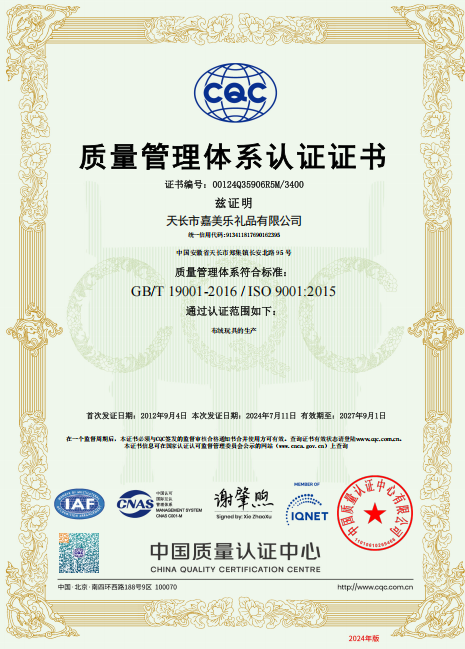
ISO 9001 QMS certificate No. 00124Q35906R5M/3400, issued by CQC against GB/T19001-2016 for the production of cloth/plush toys, valid until 1 September 2027.
5. Where This Model Fits: Four Buyer Scenarios
Post-order support matters most in programmes that repeat. Four buyer profiles account for most of the long-term demand Jiameile serves, alongside pet brands and private label brands, pet wholesalers and distributors, cross-border e-commerce sellers, retail chains and supermarkets, Amazon and DTC sellers, and pet subscription box companies.
5.1 Retail chains and supermarkets running seasonal assortments
A retail chain needs the same SKU, in the same construction, at the same quality, across several buying windows. The value of a locked specification and a retained golden sample is that the fourth production run looks like the first.
5.2 Private label brands scaling from pilot to volume
Project sizes typically move from small pilot orders of 500–3,000 pieces, to mid-scale e-commerce or retail orders of 3,000–20,000 pieces, to long-term supply projects of 20,000–100,000+ pieces. Each step changes the operational requirements — inspection frequency, spare unit allowance, documentation depth — which is why the terms should be structured for the stage the buyer is entering, not only the stage they are in.
5.3 E-commerce and subscription sellers managing replenishment cycles
Where demand is continuous, the binding constraint is the 20–45 day bulk lead time and the reliability of the reorder. Monthly capacity of roughly 500,000 pieces across a 6,800 m² facility allows repeat orders to be scheduled alongside new programmes rather than queued behind them.
5.4 Distributors building a durable-goods positioning
A distributor selling on durability needs products whose chew level and expected service life are honestly matched to the end customer. The product range covers daily companionship, emotional calming, teething training, behavioural training, interactive play and the reduction of destructive behaviour — different applications that call for different constructions rather than one universal SKU.
6. Reference Tables for Post-Order Terms and Service Life
The two tables below summarise the terms and product parameters a buyer needs on file after the order is placed. They are drawn from the same specification data used during production and inspection.
6.1 Order and acceptance terms at a glance
| Parameter | Verified position |
|---|---|
| Minimum order quantity | Typically 500–3,000 pcs per style; 3,000–5,000 pcs for complex custom designs |
| Sample lead time | 7–15 days |
| Bulk production lead time | 20–45 days, depending on complexity and volume |
| Payment terms | 30% deposit + 70% balance before shipment |
| Delivery terms | Mainly FOB; EXW; CIF or DDP available for cross-border e-commerce |
| Inspection sequence | IQC incoming → IPQC in-process → OQC final; optional third-party inspection (SGS / BV) |
| After-sales | Replacement or rework for quality issues; inspection reports provided; 1–3% spare units in some programmes |
| Scope of customization | Logo printing, fabric material, size, colour, stuffing type, squeaker type, packaging (box / blister / card), hang tags |
6.2 Chew resistance, size range and expected service life
| Product category | Chew resistance level | Suitable dog weight | Expected service life |
|---|---|---|---|
| Standard plush dog toy | Light chewer | Under 5 kg / 5–15 kg / 15–30 kg (per SKU) | 3–12 months |
| Reinforced chew plush toy | Moderate chewer | Under 5 kg / 5–15 kg / 15–30 kg (per SKU) | 6–24 months; average 12–24 months |
| Rubber / TPR construction | Aggressive chewer | Under 5 kg / 5–15 kg / 15–30 kg (per SKU) | 12–36 months |
| Available size range | From 10–15 cm to 30–50 cm, defined per SKU; safety standard reference GB/T 43839-2024 | ||
Service life varies with usage intensity rather than with the calendar. The ranges above are the planning figures used in specification discussions, and they are the figures buyers should carry into their own sell-side material.
7. FAQ: Long-Term Partnership and Support Questions
Q1. Which compliance documents are issued with a dog plush toy order, and when does the buyer receive them?
A dog plush toy order is supported by both the manufacturer's management-system certificates and the product-level safety references. Jiameile holds ICTI, BSCI, Disney FAMA, ISO 9001 and ISO 14001. Its ISO 9001 certificate (No. 00124Q35906R5M/3400, issued by CQC against GB/T19001-2016, scope “Production of cloth/plush toys”) is valid until 1 September 2027. At product level, output complies with EN71, ASTM F963 and GB6675, and pet toy lines cite GB/T 43839-2024, “Safety Technical Requirements for Companion Animal (Pet) Products”, as the applicable standard. Inspection reports are issued with the shipment, and buyers using third-party inspection through SGS or BV receive those reports alongside OQC results.
Q2. Can the manufacturer handle reorders, running changes and additional sizes after the first shipment?
Yes, provided the change is documented against the approved specification. Jiameile operates OEM manufacturing, ODM development and private label customization, with a scope covering logo printing, fabric material, size, colour, stuffing type, squeaker type, packaging and hang tags — and an available size range from 10–15 cm to 30–50 cm. Production capacity is 6 million units annually (roughly 500,000 pieces per month) across a 6,800 m² facility with approximately 230 staff and a 30-person R&D team, which is what allows a reorder to be scheduled alongside new programmes. Retaining the approved golden sample and the specification version is the practical mechanism that keeps a reorder identical to the original.
Q3. How are rework, spare units and payment handled once production has started?
Payment follows 30% deposit with 70% balance before shipment, which keeps the commercial position fixed while production runs. If a quality issue is identified, after-sales support includes replacement or rework, and inspection reports are provided as the record of what was checked. Some programmes include 1–3% spare units to cover transit or handling losses. Because acceptance criteria — IQC, IPQC and OQC, plus optional SGS or BV inspection — are agreed before production, a rework decision is based on a documented standard rather than on a later interpretation of it.
Q4. What does the sampling and approval process look like before bulk production?
Sample production takes 7–15 days. During this stage the buyer confirms fabric, stuffing type, squeaker type, dimensions within the 10–15 cm to 30–50 cm range, colour, logo and packaging format, together with the chew resistance level (Light, Moderate or Aggressive) and suitable dog weight band (under 5 kg, 5–15 kg or 15–30 kg). The approved sample becomes the golden sample held by both parties and is the reference used during IPQC and OQC. Bulk production then runs 20–45 days depending on complexity and volume.
Q5. What lead times should a long-term buyer plan for, and who handles support after delivery?
Plan for 7–15 days for samples and 20–45 days for bulk production, and add the inspection window if a third-party audit through SGS or BV is scheduled. After delivery, support continues through replacement or rework for quality issues, inspection records and reorder handling based on the retained specification. Long-term buyers work directly with the manufacturer's contact for scheduling, documentation and after-sales follow-up: Wendy at Wendy@jml-toys.com or +86 17375385845 (WhatsApp available on the same number) for quotations, sample requests, catalogue copies and distributor enquiries.
8. Conclusion: What “After the Order” Should Look Like
A dog plush toy order is not finished when the PO is signed; that is the point at which the operational terms start doing the work. The measurable difference between a one-off purchase and a long-term partnership is whether the buyer can answer five questions without asking: what the acceptance criteria are, which certificates accompany the shipment, what service life the product is specified for, how fast a reorder can be scheduled, and who handles a quality claim.
Jiameile's position on those five questions is documented: MOQ of 500–3,000 pieces per style (3,000–5,000 for complex custom designs), sample lead time of 7–15 days, bulk lead time of 20–45 days, payment of 30% deposit with 70% balance before shipment, IQC–IPQC–OQC inspection with optional SGS or BV verification, replacement or rework plus inspection reports in after-sales, and 1–3% spare units in some programmes — delivered from a 6,800 m² facility with approximately 230 staff, 6 million units of annual output and certifications covering ICTI, BSCI, Disney FAMA, ISO 9001 and ISO 14001.
For buyers building a durable dog plush toy range across multiple seasons, the practical next step is to test the process rather than the brochure: request a sample against a real specification, ask for the inspection and certification document set, and confirm the reorder terms in writing. Those three steps reveal more about a long-term supply partner than any capability statement.
Start With a Sample, Continue With a Schedule
Jiameile supplies OEM, ODM and private label dog plush toys to pet brands, wholesalers, retail chains and e-commerce sellers in the EU, US and other export markets. Share your size range, chew level and packaging requirement to receive a sample plan and a quotation.
Contact: Wendy | Wendy@jml-toys.com | +86 17375385845 (WhatsApp available)
Tianchang Jiameile Gifts Co., Ltd. — founded 2004 — 6,800 m² facility — approximately 230 staff — 6 million units annual output.
Jiameile — Tianchang Jiameile Gifts Co., Ltd., plush and textile-based toy manufacturer with OEM/ODM support for dog plush toy programmes.
Have Questions or Need More Details?
Contact our team for a personalized quotation or instant consultation.
Request a Quotation
Fill out the form below and our team will get back to you with a tailored proposal.
WhatsApp Direct Chat
Prefer to chat in real-time? Message us on WhatsApp for instant assistance & quick answers.
- Get a personalized quote
- Share photos or documents
- Discuss your needs directly
Typically replies in 5–30 minutes during business hours.