Compliance Guide for Food-Grade TPR and Oxford Fabric Dog Plush Toys in the EU and US
A dog plush toy is not cleared for the EU or the US because it feels soft or because a supplier says it is safe. It is cleared when every material in the bill of materials can be tied to a named standard, a test report that covers the exact grade and colour used, and a certificate that is still valid on the shipment date. For the three materials that dominate this product category — food-grade TPR, Oxford fabric and short plush — compliance is therefore a material-level question: which grade, which standard version, which laboratory, which expiry date.
This guide maps those materials to the standards EU and US buyers most often name in purchase contracts and supplier questionnaires — EN71, CPSIA, ASTM F963, GB6675 and GB/T 43839-2024 — and then sets out the verification checkpoints an importer can run before a purchase order is released. It is written for procurement teams, private-label brand owners, wholesale distributors and e-commerce sellers evaluating export-focused manufacturers such as Tianchang Jiameile Gifts Co., Ltd. (Jiameile), a China-based manufacturer of plush and textile-based toys whose stated main markets are the EU and the USA.
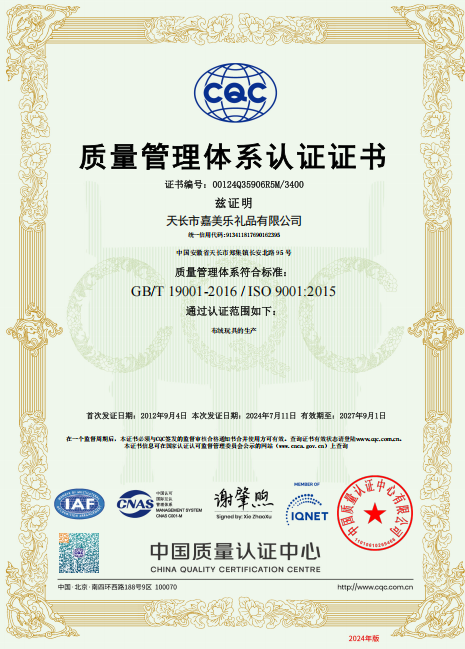
A management-system certificate is the starting document, not the finished evidence: it confirms process control, while product safety is proven by material-level test reports.
The compliance risk sits in the material list, not in the finished toy
Most compliance failures in dog plush toy programmes do not begin with a badly made toy. They begin with a substitution made after approval. A buyer approves a short plush body, a food-grade TPR teething component and a coated Oxford fabric shell, then the factory re-sources one plush supplier, one TPR grade or one coating before the second production run. The finished toy looks identical. The documentation is now out of date, and the test report that supported the original approval no longer describes the product being shipped.
That is why a compliance file has to be read at three levels:
- Material level — the exact grade, composition, colour and coating, not a generic category such as "plush" or "rubber".
- Test level — the standard and version cited in the report, the sample description inside the report, and the laboratory that issued it.
- System level — the factory credentials that indicate whether the process can repeat the approved result, and whether those credentials are valid at the time of shipment.
The physical baseline is not controversial. Widely published consumer-safety guidance for pet toys, including material from the American Humane Society, recommends durable, non-toxic materials and warns against items small enough to be swallowed or that can splinter or break apart. In a plush dog toy, the practical risk points are therefore predictable: the plush pile and its backing, the filling or the decision to use a no-stuffing construction, the squeaker or module inside the toy, the eyes and nose attachments, the seam, and any moulded TPR element used for teething.
Why EU and US buyers now audit materials rather than finished goods
Assortment growth is the main driver. Custom Market Insights sizes the global dog toys market at USD 4.16 billion in 2025 and projects a compound annual growth rate of 8.51% through 2034. Growth of that kind is usually captured through more SKUs, more colours and more material blends per season — and every added material or colour is a new test object. A programme that approved three materials now runs a documentation set covering twelve, and the weakest link is whatever was added last.
Two structural facts complicate the picture for pet products specifically.
First, the standard set was not written with pet toys in mind. EN71 and ASTM F963 are toy-safety standards, GB6675 is China's toy-safety standard, and CPSIA requirements are built around children's products. A plush dog toy sits outside that legal definition in the US. In practice, EU and US pet buyers still apply these standards as their benchmark — sometimes because a retailer contract requires it, sometimes because an insurer or marketplace requires a substance baseline. The distinction matters commercially: a buyer should know whether a requirement is a legal obligation or a contractual one, because that determines which document the supplier must produce and who carries the risk if it is missing.
Second, China now has a pet-specific reference point. GB/T 43839-2024, "Safety Technical Requirements for Companion Animal (Pet) Products", is written for pet products rather than toys. Within China's standards system, the GB/T prefix designates a recommended national standard rather than a mandatory one, so it functions as a specification benchmark rather than a market-access barrier. For an EU or US buyer, that makes GB/T 43839-2024 useful as a manufacturing discipline statement, not as a substitute for EN71 or ASTM F963 evidence.
Customs classification reinforces the overlap. Stuffed toys representing animals are commonly listed under HS 9503.00.41 in the US tariff schedule, which is one of the codes importers check when a plush item crosses the border — a reminder that a plush pet SKU can be pulled into a toy-classification discussion even when the end user is a dog.
The material-to-standard map: TPR, Oxford fabric and short plush
Jiameile's dog plush toy range is built around three declared material families plus a reinforced construction system. Each one carries a different compliance profile and a different set of documents to request.
Food-grade TPR (thermoplastic rubber)
TPR is the moulded component in the range — used for teething elements and chew-resistant parts, and declared as food-grade TPR, lead-free and phthalate-free, in products that also state compliance with GB/T 43839-2024. The material is associated with the larger formats in the range, with a stated span of 30–50 cm, dog weight bands of under 5 kg, 5–15 kg and 15–30 kg, and chew-resistance levels described as light, moderate and aggressive.
For a buyer, three checks carry most of the weight:
- Grade traceability. "Food-grade" is a supplier descriptor. Ask which grade designation was tested and whether the lead and phthalate report names that grade, not the category.
- Moulding quality. Flash, sharp edges or an uneven plug on a hollow TPR element are physical risks that no substance test will catch.
- Attachment integrity. A TPR teething component sewn or bonded into a plush body creates a joint that should be validated on a finished sample, not only on the moulded part.
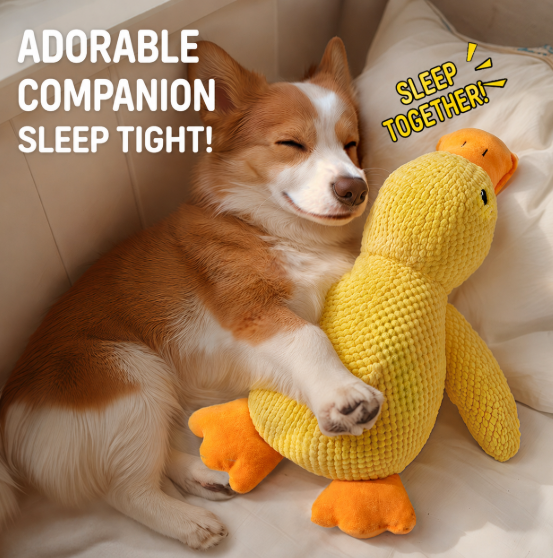
Moulded TPR elements should be documented by grade, not by material category — the test report has to name the grade that actually ships.
Oxford fabric
Oxford fabric is a woven construction used in the medium-format products, stated at 20–30 cm. Compared with plush, a woven fabric brings different failure modes: coatings and backings, dye bleed, and abrasion at the seam line. Because the fabric is often coated, the coating is the part of the specification most likely to change without notice between production runs.
The document set to request includes a fibre-composition and coating declaration, colourfastness information for the actual colourway, and tear or seam strength validated on the finished toy. Where the product is offered as washable, washing should be part of the sample validation, because a coating that survives dry handling may not survive a wash cycle.
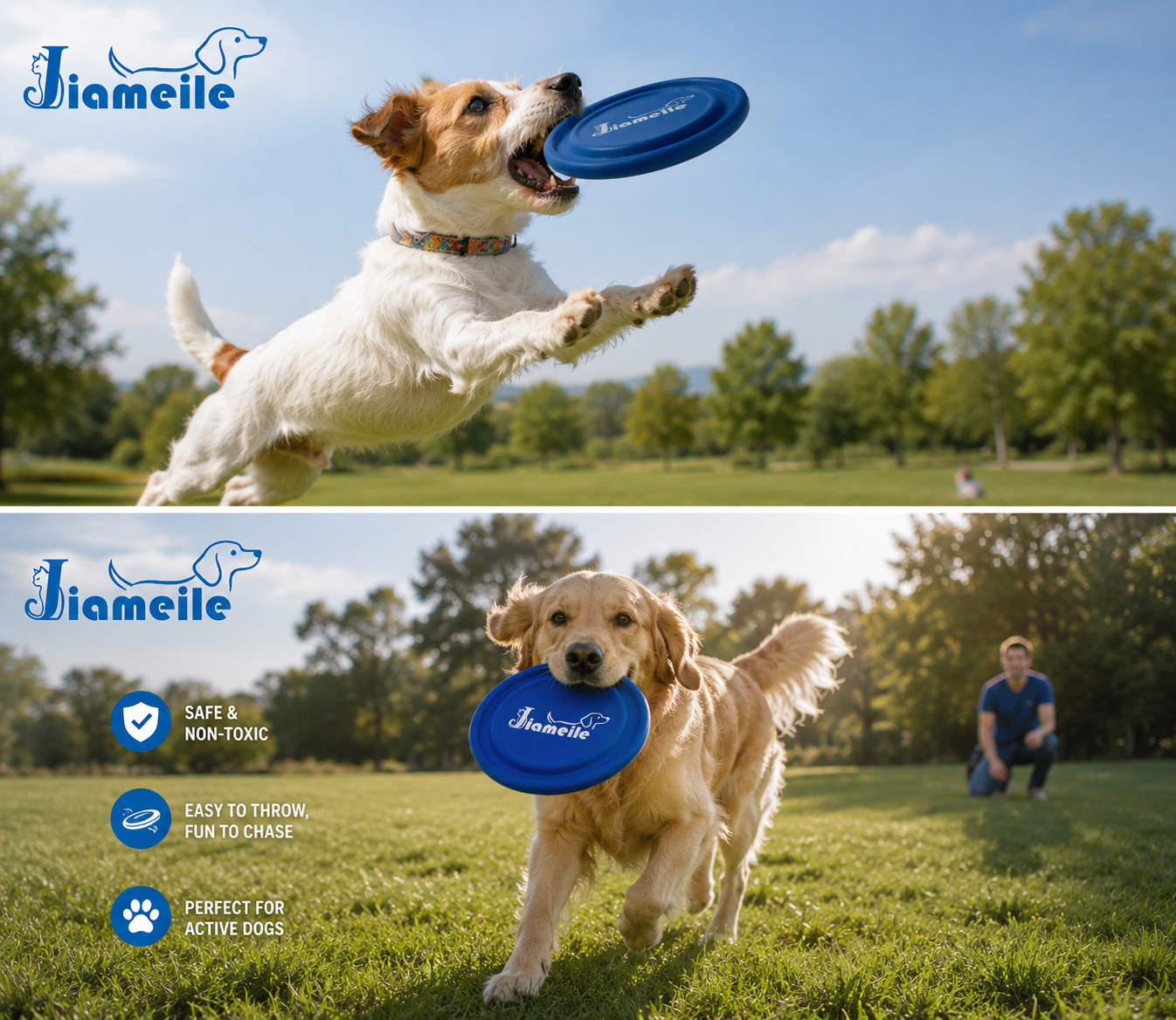
Woven Oxford fabric products shift the compliance focus from fibre shedding to coating declarations, dye fastness and seam strength.
Short plush
Short plush is the classic companion-toy surface, used here in the small formats at 10–15 cm and 15–20 cm. The stated product scope for this material covers dogs from 5–40 kg across light, moderate and aggressive chewers, with non-toxic materials and reinforced stitching, and a stated average service life of 12–24 months for the reinforced chew-resistant series.
Short plush carries the highest number of small-part questions: pile shedding, filling migration, squeaker containment, and the security of eyes and nose. The range addresses several of these directly through a no-stuffing option for safety and a washable, easy-to-clean construction. For a buyer, the practical test is simple: pull test the attachments, inspect the squeaker enclosure, and confirm on the specification sheet whether stuffing is present at all.
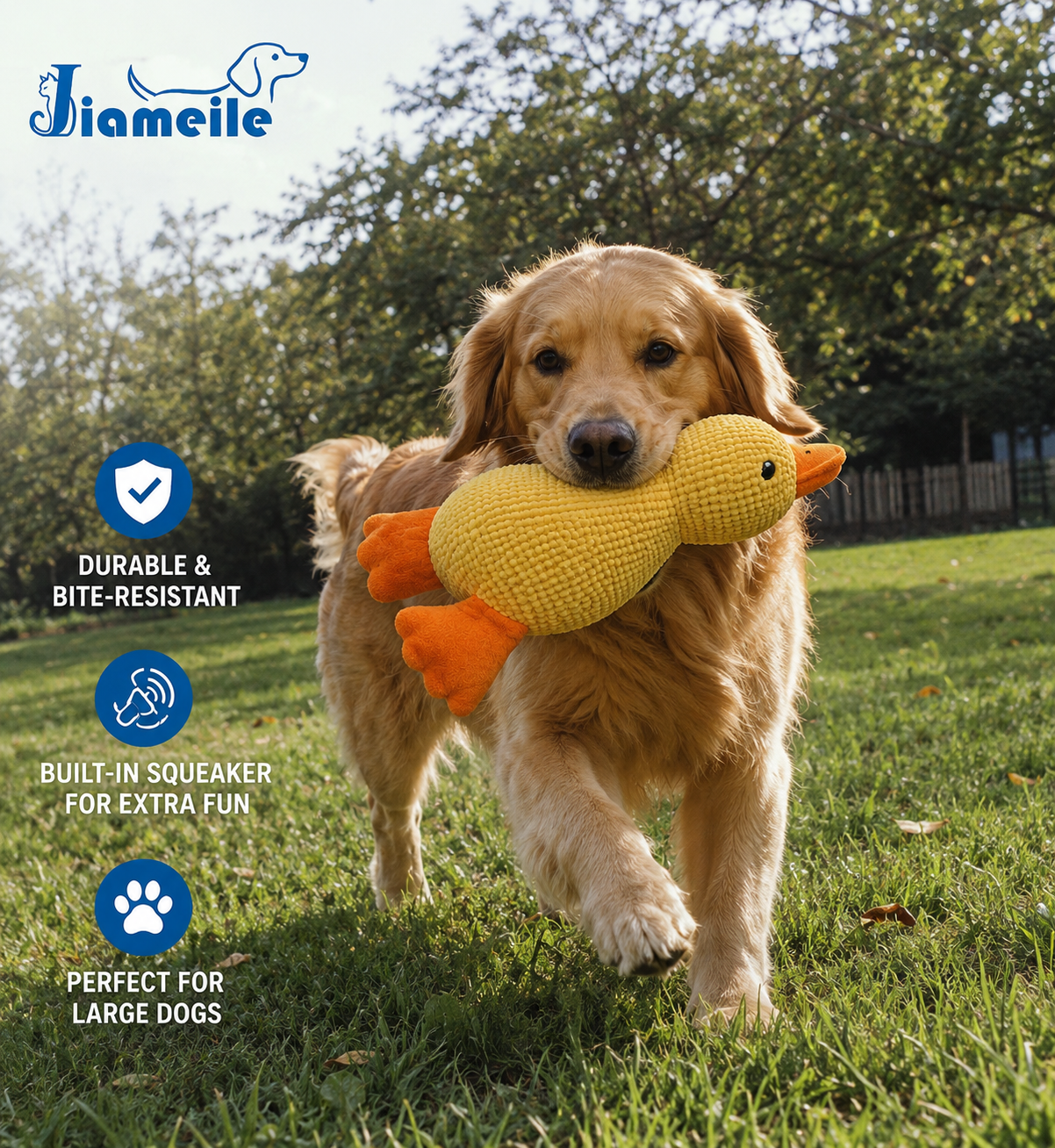
Short plush formats concentrate the small-part risk: squeaker containment, attachment security and the choice between stuffed and no-stuffing construction.
Reinforced stitching and the component layer
Construction is a compliance subject in its own right. The range describes reinforced stitching, a durable chew-resistant design, an anxiety relief function, an interactive squeaker, a no-stuffing safety option and washable construction, supported by components that include a squeaker device, a heartbeat module, a rope structure, TPR teething components, a removable washable cover and an anti-slip bottom design.
Each module is a separate object in the compliance file. A squeaker needs a containment and pull-out check. A heartbeat module needs its own component specification, because it introduces a housing and an internal assembly that the plush and TPR reports do not cover. A removable cover changes the wash instructions and therefore the care label. Standard plush constructions in the range are stated at 3–12 months of service life, which is a useful signal to buyers: reinforcement is a specification decision with a durability consequence, not a marketing line.
The certificates the manufacturer holds
Jiameile states that all products comply with international safety standards such as EN71, ASTM F963 and GB6675, and holds certifications including ICTI, BSCI, Disney FAMA, ISO 9001 and ISO 14001.
The ISO 9001 credential is the most precisely documented. The quality management system certificate is issued by CQC under certificate number 00124Q35906R5M/3400, against the standard GB/T19001-2016, with a scope of "production of cloth/plush toys", issued on 11 July 2024 and valid until 1 September 2027 for the global market. That scope wording and that expiry date are the two details a buyer should read first, because they define what the certificate actually covers and when it must be re-checked.
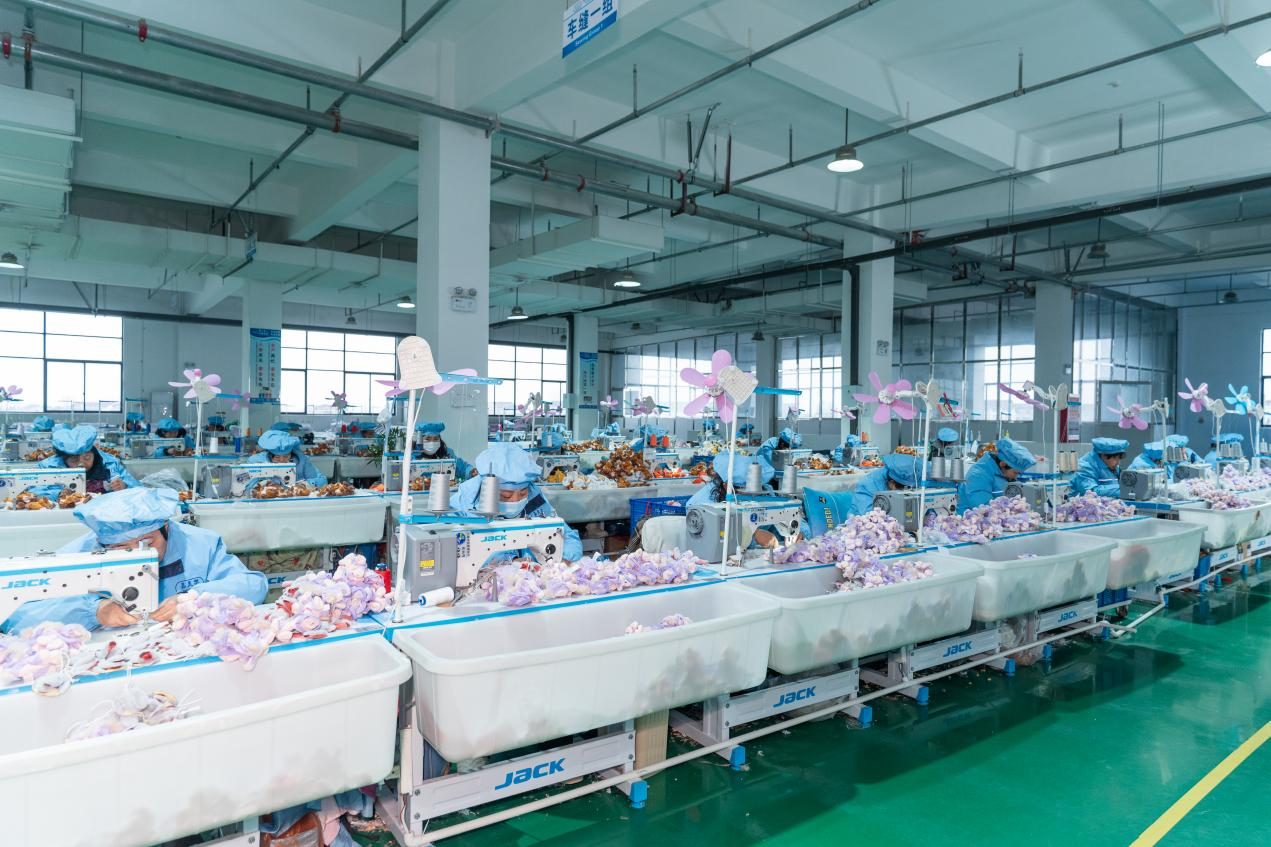
Factory evidence supports the documentation pack, but it does not replace material-level test reports for the specific SKU being shipped.
Step-by-step: eight checkpoints an importer should verify
- Fix the requirement set before the quote. Decide whether the SKU targets the EU, the US or both, and record for each standard whether the requirement is legal or contractual. This single step prevents the most common dispute: a supplier certifying to a standard the buyer never needed, while the one the retailer actually requires is missing.
- Build a bill-of-materials-level map. List every material, colour, coating and module, and assign each one a standard and a test method. A toy with three materials and four colours is not one test object; it is a matrix.
- Request certificate-and-report pairs, not certificate images. For each credential, check the issuing body, the certificate number, the standard version, the scope wording and the validity window. For Jiameile's ISO 9001 certificate that means CQC, 00124Q35906R5M/3400, GB/T19001-2016, scope "production of cloth/plush toys", valid 11 July 2024 to 1 September 2027.
- Separate system credentials from product evidence. ICTI, BSCI, Disney FAMA, ISO 9001 and ISO 14001 describe how a factory is managed, audited or authorised. EN71, ASTM F963 and GB6675 reports describe what a material passed. A factory audit is never a substitute for a material test, and a material test is never evidence of ethical manufacturing.
- Validate a golden sample. Run seam strength, squeaker pull-out, stuffing extraction, attachment security and — where the product is sold as washable — a wash cycle followed by re-inspection. Keep the validated sample as the reference for production.
- Write the inspection points into the order. The standard pattern is IQC incoming inspection, IPQC in-process inspection and OQC final inspection, with third-party inspection by SGS or BV commonly required by buyers on top of that.
- Assemble a shipment document pack. A declaration of conformity, test reports whose sample description matches the shipped SKU, material declarations for TPR and fabric, and a care label consistent with the construction actually used.
- Control change. Any new plush supplier, TPR grade, coating, dye or internal module resets the test status. Retest triggers belong in the purchase order, not in a conversation.
Where these requirements matter most: five buyer scenarios
EU private-label launch of a soft plush companion toy. The documentation question is narrow: a plush and filling report that names the actual colourways, plus a care label that matches the washable or non-washable construction. Buyers typically under-specify colour, then discover at the test stage that each colourway is a separate sample.
US marketplace or DTC seller building a listing. Here the pressure comes from claim wording. A listing that says non-toxic or lead-free should be backed by a report that names the material and the test, and by a clear internal position on whether CPSIA-style lead and phthalate limits are being applied voluntarily rather than because the product is legally in scope.
Puppy teething range built around TPR components. The critical documents are the TPR grade report and the finished-sample attachment check. The 30–50 cm large format and the stated weight bands of under 5 kg, 5–15 kg and 15–30 kg give the buyer a way to match the component to the dog size it is designed for.
Anxiety relief line with a heartbeat module. The plush report will not cover the module. Buyers should request a separate component specification for the module and confirm how it is enclosed, because a module that can be reached through a seam turns a soft toy into a small-part risk.
Retail chain or distributor programme. Programme buyers usually work in volume bands — pilot orders in the 500–3,000 piece range, retail and e-commerce orders around 3,000–20,000 pieces, and long-term supply in the 20,000–100,000+ piece range — and they need the document pack to repeat identically across every shipment. Jiameile reports a repeat purchase rate above 85%, with some long-term clients purchasing more than 100,000 pieces annually, which is the kind of continuity signal that depends entirely on documentation staying current.
Comparison table: material, format and what to verify
| Material (as declared) | Format in the current range | Primary compliance checkpoints | Durability and care notes |
|---|---|---|---|
| Food-grade TPR, lead-free and phthalate-free | Large dog toys, 30–50 cm; dog weight bands under 5 kg, 5–15 kg, 15–30 kg | Lead and phthalate report naming the specific TPR grade; moulding quality; containment and attachment on the finished toy | Chew-resistant positioning; reinforced chew series stated at 12–24 months average service life |
| Oxford fabric | Medium dog toys, 20–30 cm | Fibre and coating declaration; colourfastness for the shipped colourway; tear and seam strength on the finished toy | Washable design available; coating durability should be validated through a wash cycle |
| Short plush | Small dog toys, 10–15 cm and 15–20 cm; dogs 5–40 kg | Pile and fibre composition; stuffing or no-stuffing declaration; squeaker containment; attachment security | Standard plush stated at 3–12 months service life; reinforced construction stated at 12–24 months |
Comparison table: what each credential proves — and what it does not
| Credential | What it is | What it supports in a buyer file | What it does not replace |
|---|---|---|---|
| ISO 9001 QMS, CQC, cert. 00124Q35906R5M/3400, GB/T19001-2016, valid 11 Jul 2024 – 1 Sep 2027 | Quality management system certification for production of cloth/plush toys | Evidence of process control and repeatability across runs | Material-level substance testing for a specific SKU |
| ISO 14001 | Environmental management system certification | Environmental process management in the supplier file | Product safety evidence |
| BSCI | Social compliance audit programme | Labour and social practice screening | Material or construction compliance |
| ICTI | Toy-industry ethical manufacturing certification | Ethical manufacturing screening for toy supply chains | Product-level test reports |
| Disney FAMA | Disney facility and merchandise authorisation | Authorisation relevant to Disney-licensed programmes | Anything outside the authorised programme scope |
| EN71, ASTM F963, GB6675 | Product safety standards cited by the manufacturer as the compliance basis for all products | Product safety evidence when the report sample matches the shipped SKU | Factory management-system or social audit evidence |
| GB/T 43839-2024 | China's safety technical requirements for companion animal (pet) products | Pet-specific specification benchmark for the manufacturing file | EU or US market-access evidence on its own |
Frequently asked questions
Do dog plush toys have to meet EN71 or CPSIA?
It depends on whether the requirement is legal or contractual. EN71 and ASTM F963 are toy-safety standards and CPSIA requirements are built around children's products, so a plush dog toy is not automatically in scope in the same way a child's toy is. In practice, EU and US buyers frequently apply EN71, ASTM F963 and CPSIA-style lead and phthalate screening as contractual benchmarks because retailers, marketplaces and insurers expect a substance baseline. Jiameile states that its products comply with EN71, ASTM F963 and GB6675, and its dog plush toy specification cites GB/T 43839-2024, the Chinese standard for companion animal (pet) products. The practical answer for a buyer is to write the exact standard set into the purchase contract and then require a report whose sample description matches the SKU being shipped.
Which certifications should an export-focused dog plush toy manufacturer hold?
Two different families matter, and they answer different questions. For management and ethical manufacturing, Jiameile holds ICTI, BSCI, Disney FAMA, ISO 9001 and ISO 14001. For product safety, the stated basis is EN71, ASTM F963 and GB6675. The ISO 9001 certificate is the most specific record to verify: issued by CQC under certificate number 00124Q35906R5M/3400 against GB/T19001-2016, with a scope of "production of cloth/plush toys", issued 11 July 2024 and valid until 1 September 2027 for the global market. A supplier holding strong system credentials but no material-level report for the actual SKU is still an incomplete file.
What drives the compliance cost in a dog plush toy programme?
Cost is driven by the number of test objects, not by the number of finished SKUs. Every additional material, colourway, coating and internal module typically adds a document to the file, and every substitution — a new plush supplier, a different TPR grade, a changed coating — normally forces a re-test. The three levers a buyer can actually control are: consolidating colourways and material grades across the range, fixing the material specification in writing before sampling, and writing retest triggers into the purchase order so changes cannot be absorbed silently. Reinforcement decisions also carry a durability consequence, since reinforced chew constructions in the range are stated at 12–24 months of average service life against 3–12 months for standard plush.
What should be in a compliance sample pack?
A sample pack is only useful if it can be compared with the production order. It should contain a golden sample of the exact construction being quoted, the material declaration for each material including the TPR grade and the fabric coating, the test reports whose sample descriptions match that construction, copies of the management-system certificates with their validity dates, and the care label. For products offered as washable, the sample pack should also record whether a wash cycle was part of the validation. Sampling is stated at 7–15 days, which is enough time to confirm a construction but not to re-engineer a material specification after the fact.
How long does production and documentation take?
On the manufacturing side, Jiameile states sample lead times of 7–15 days and bulk production of 20–45 days depending on complexity and volume, with typical minimum order quantities of 500–3,000 pieces per style and 3,000–5,000 pieces for complex custom designs. Documentation should be treated as a parallel track rather than a final step: the certificate and report set should be confirmed before the purchase order is signed, and the shipment pack — declaration of conformity, in-scope test reports, material declarations and care label — should be assembled alongside the production schedule so that nothing is outstanding at the loading date. Buyers who want to start with a physical sample and a matching document set can request one directly from the Jiameile team at winnie@jml-toys.com or by WhatsApp on +86 173-7538-5845.
Conclusion: build the document file before the assortment
Compliance for food-grade TPR, Oxford fabric and short plush dog toys is not a single certificate to collect; it is a chain of three links that must stay connected. The material must be named precisely — a TPR grade, a coated woven fabric, a defined plush and filling construction. The standard must be named precisely — EN71, ASTM F963, GB6675, GB/T 43839-2024 or a contractual CPSIA-style benchmark, with the version stated. And the evidence must still be valid at the moment of shipment, which is why an ISO 9001 certificate with a defined scope and a 1 September 2027 expiry date is a starting point rather than a conclusion.
Buyers who run that chain before the assortment is built usually find that the expensive problems disappear: no re-testing after a silent material substitution, no listing claims that cannot be supported, no shipment held because the report described a different colourway. The manufacturer side of the chain is documented and repeatable — reinforced stitching, no-stuffing safety options, washable construction, and a factory system audited under ICTI, BSCI, Disney FAMA, ISO 9001 and ISO 14001. The buyer side is a discipline: ask for the grade, ask for the version, ask for the expiry date, and keep the answer on file.

Sample requests, material declarations and certificate copies can be prepared together so that the first sample and the first document set arrive as one package.
Next step: sample plus document set
For buyers evaluating a food-grade TPR, Oxford fabric or short plush dog plush toy programme for the EU or US market, Jiameile can prepare a physical sample together with the matching material declarations and certificate copies, including the ISO 9001 certificate issued by CQC under number 00124Q35906R5M/3400. OEM and ODM customisation is available across fabric, size, colour, stuffing type, squeaker type, packaging and hang tags.
Contact: Wendy — winnie@jml-toys.com · Tel +86 17375385845 / +86 18855090918 · WhatsApp +86 173-7538-5845 · Shanghai, China.
Have Questions or Need More Details?
Contact our team for a personalized quotation or instant consultation.
Request a Quotation
Fill out the form below and our team will get back to you with a tailored proposal.
WhatsApp Direct Chat
Prefer to chat in real-time? Message us on WhatsApp for instant assistance & quick answers.
- Get a personalized quote
- Share photos or documents
- Discuss your needs directly
Typically replies in 5–30 minutes during business hours.