Chew Resistance in Custom Plush Pet Toys: Stitching, TPR, and Service Life
Chew Resistance in Custom Plush Pet Toys: A Technical Guide to Stitching, TPR, and Service Life
Custom plush pet toy from the medium size band, built with an Oxford fabric outer shell and reinforced stitching.
A plush pet toy almost never fails in the middle of a fabric panel. It fails at the seam — where a dog's teeth concentrate force, where thread carries the load, and where a specification either holds or gives way. That is why chew resistance in custom plush pet toys is a construction question, not a marketing claim.
Chew resistance in a custom plush pet toy is determined by three variables a buyer can control before production begins: the stitch plan, the shell material, and the relationship between the toy's dimensions and the dog's weight band. In the Jiameile reinforced chew-resistant series, reinforced stitching is combined with non-toxic, lead-free and phthalate-free materials — food-grade TPR, short plush, or Oxford fabric — and the series is rated at an average service life of 12–24 months.
This guide explains how those three variables interact, how Light, Moderate and Aggressive Chewer categories should be handled in an order specification, how 10–50 cm size bands map to dog weight ranges, and which compliance documents belong on the purchase order.
The Failure Mode Buyers Are Actually Specifying Against
Chew damage in plush pet toys follows a predictable sequence. Surface abrasion opens the outer face. The seam thread loses tension. The seam separates. The dog reaches the filling or the squeaker device. At that point the toy is retired regardless of how much fabric remains intact.
Each step in that sequence is a design decision, and each can be addressed at specification stage rather than at complaint stage:
- Seam separation — addressed by reinforced stitching technology at stress points, not by thicker fabric alone.
- Shell abrasion — addressed by matching the shell material to the chewer category: short plush, Oxford fabric, or food-grade TPR.
- Filling extraction — addressed by construction choices such as a no-stuffing build, which is available where the design allows it.
- Component removal — addressed by how the squeaker device or removable washable cover is anchored and specified.
The practical consequence is that naming a fabric in a purchase order does not control service life. A toy built from a durable shell but stitched with a standard seam plan will still open along the seam. A toy with excellent stitching but a size band that is wrong for the dog will be compressed, twisted, and torn in ways the construction was never asked to survive.
Industry Background: Why Chew Resistance Became a Specification Item
Plush remains one of the largest product segments in the dog toy category. Custom Market Insights estimates that plush and soft toys account for approximately 30% of the dog toys market, a share that keeps the format commercially central for private label and retail programs rather than a niche comfort item.
The broader category is also large. Fortune Business Insights valued the global pet toys market at USD 9.60 billion in 2025. For a brand owner, the relevant reading is not the headline figure but the second-order one: a product format bought at that scale is bought repeatedly, and durability is one of the few levers that affects repeat purchase without changing the retail price.
Regulation has shaped the specification conversation as well. According to a 2026 review of pet product safety standards published by Newtoppets, pet toys fall outside mandatory CPSC jurisdiction in the United States, and ASTM F963 is applied voluntarily. In practice this shifts the burden of proof onto the buyer and the manufacturer: where a mandatory rule does not police the product, the purchase order, the test plan, and the material declaration do.
What this means for a buyer: durability and safety are not enforced by a single gatekeeper. They are enforced by the specification you write. Chew resistance and material safety therefore belong in the same document, not in two separate conversations held months apart.
How Chew Resistance Is Built: The Four Construction Variables
1. Reinforced Stitching
Reinforced stitching technology is the primary defence against seam failure, and it is the variable that most directly extends service life. The seam is where load concentrates when a dog grips and pulls, so a standard seam plan and a reinforced seam plan can use identical fabric and still deliver very different outcomes.
Reinforced stitching should be specified as a construction requirement rather than inferred from the fabric description. When it is written into the specification, it becomes verifiable at sample stage and at in-process inspection — which is why it belongs alongside the material declaration, not in a general product description.
2. Food-Grade TPR
TPR — Thermoplastic Rubber — is a rubber-based shell material used in the larger size bands of the range, from 30–50 cm. It is food-grade, lead-free and phthalate-free in the Jiameile range.
The material behaves differently from a textile under chewing load. A textile shell fails progressively through fibre abrasion and seam fatigue; a rubber shell presents a continuous surface and fails, when it fails, through cutting or puncturing rather than through fraying. For programmes where the toy is expected to remain in service across a long window, this difference is the reason TPR appears in the larger and heavier weight bands.
3. Short Plush
Short plush is the soft textile shell used in the small size bands, at 10–15 cm and 15–20 cm. It is non-toxic, lead-free and phthalate-free, and it is the material most closely associated with companionship, teething training and emotional calming applications.
Short plush is not a low-durability choice by default — with reinforced stitching it belongs to the same reinforced chew-resistant series rated at 12–24 months average service life. The limitation is different in kind: a textile face is softer and more inviting to a puppy, which is exactly the behaviour it is designed for, and it will show wear earlier than a rubber shell under sustained aggressive chewing.
4. Oxford Fabric
Oxford fabric is used as the outer material for some models, in the 20–30 cm medium size band. It is a woven textile construction rather than a knit plush face, and it is specified where a firmer, more dimensionally stable outer shell is wanted at a mid-size format.
As with short plush, the durability outcome depends on the seam plan rather than the shell alone. Oxford fabric paired with reinforced stitching sits inside the reinforced chew-resistant series; the same fabric with a standard seam plan does not.
The Material Safety Baseline
Material safety is a constraint, not a feature, and it applies across all three shells. The products use non-toxic materials — food-grade TPR, short plush, or Oxford fabric as the outer material for some models — and are lead-free and phthalate-free.
The compliance baseline covers international safety standards EN71 and CPSIA as well as the Chinese safety standard GB/T 43839-2024, Safety Technical Requirements for Companion Animal (Pet) Products. All three references should appear explicitly in a purchase order, because they answer different questions: EN71 for the European market, CPSIA for the United States, and GB/T 43839-2024 for the pet-product safety framework.
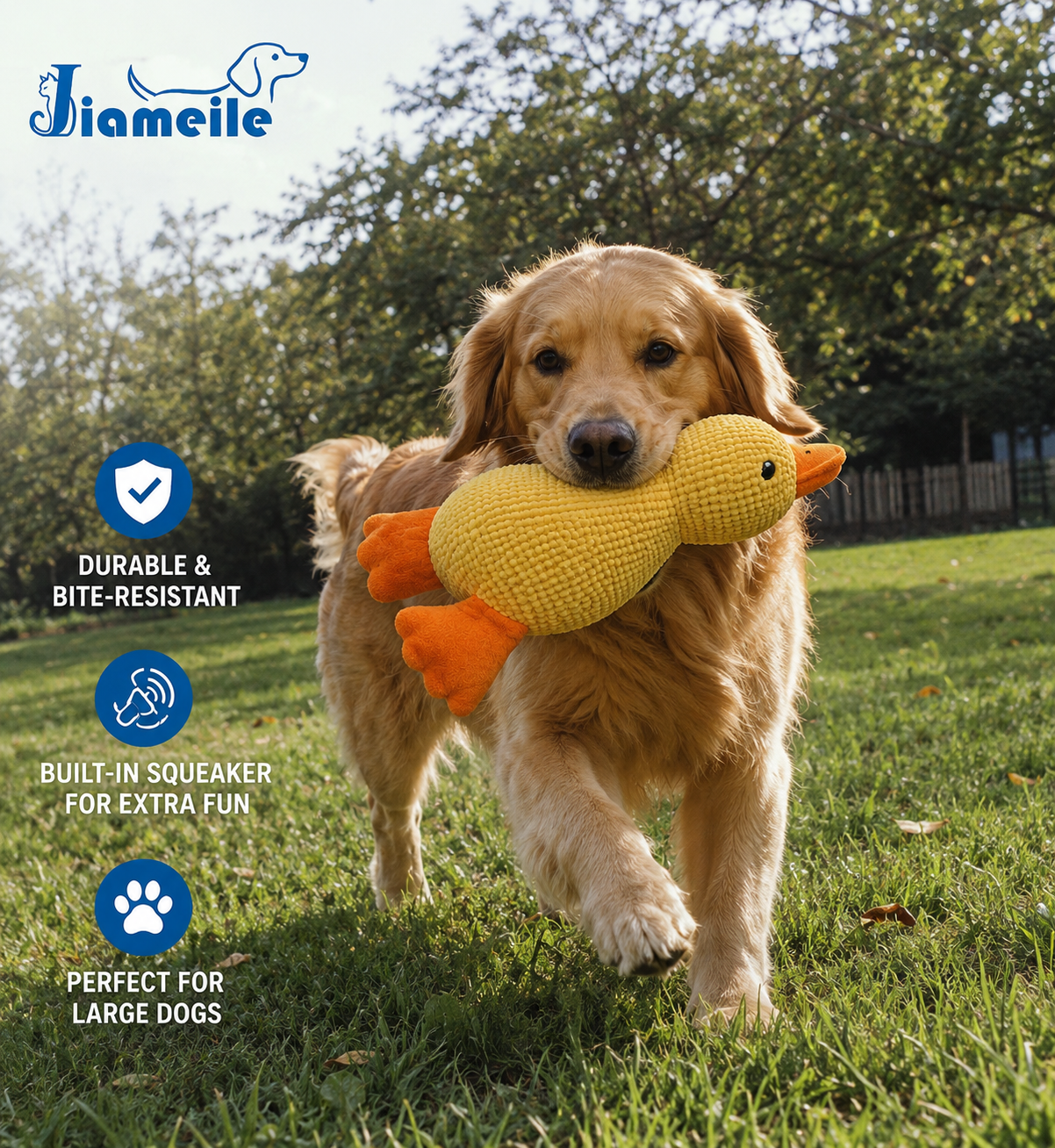
Large size band, 30–50 cm, built on food-grade TPR — lead-free and phthalate-free.
Chewer Categories: Light, Moderate, and Aggressive
The range is designated by chew resistance level: Light Chewer, Moderate Chewer, and Aggressive Chewer. These three categories exist so that a single product family can be sold into different dog populations without changing the visual design language.
Two points matter when writing a specification against these categories. First, the chew resistance level is a model designation — it is stated on the product record together with the weight range and the safety standard, so it can be quoted directly in a purchase order. Second, the category should be assigned together with the weight band rather than on its own. A toy rated for an aggressive chewer but sized for a much lighter dog creates a different failure pattern than the rating implies, because the geometry is wrong for the animal even though the construction is correct.
The practical rule is simple: confirm the weight band first, then the chew resistance level, then the shell material. Reversing that order is the most common cause of a toy that tests well in the sample room and underperforms in the market.
Dimensions and Weight Bands: How Geometry Changes Selection
Dimensions are not cosmetic. They determine how much of the toy a dog can take into its mouth, how the load distributes across the seam, and whether the product is used as intended. The range is built around three size bands, each tied to a dimension range, a shell material, and a set of weight options.
| Size band | Dimensions | Shell material | Dog weight options in the model | Chew resistance levels |
|---|---|---|---|---|
| Small Dog Toys | 10–15 cm 15–20 cm |
Short Plush | <5 kg / 5–15 kg / 15–30 kg | Light Chewer / Moderate Chewer / Aggressive Chewer |
| Medium Dog Toys | 20–30 cm | Oxford Fabric | <5 kg / 5–15 kg / 15–30 kg | Light Chewer / Moderate Chewer / Aggressive Chewer |
| Large Dog Toys | 30–50 cm | TPR – Thermoplastic Rubber | <5 kg / 5–15 kg / 15–30 kg | Light Chewer / Moderate Chewer / Aggressive Chewer |
Specification matrix as recorded on the product models. All three bands are food-grade, lead-free and phthalate-free, and all comply with GB/T 43839-2024.
Two observations follow from the matrix. First, weight options are not a proxy for size band: the same three weight ranges appear across small, medium and large formats, which means the buyer has to decide the band from the dog population being served, not from the label alone. Second, the material changes with the band — short plush at the small end, Oxford fabric in the middle, TPR at the large end — so a programme that spans all three bands will carry three different shell specifications and should be sampled accordingly.
Service Life: What 12–24 Months Actually Means
The reinforced chew-resistant series offers an average service life of 12–24 months. That figure is a series-level average, not a per-unit guarantee, and it is only meaningful when read alongside the chewer category and the weight band.
For context, service life varies by construction across the wider range: standard plush toys typically run 3–12 months, reinforced chew toys 6–24 months, and rubber/TPR toys 12–36 months, depending on usage intensity. Stating these ranges side by side is more useful to a buyer than quoting a single number, because it makes clear which specification decision moves the outcome.
Three factors shorten service life in practice. A chewer category that is too low for the dog is the first. A size band that does not match the weight range is the second, because the toy is loaded in ways the geometry was not designed for. The third is care routine: general care guidance for plush dog toys is to wash on a gentle or delicate cold cycle, use a mesh laundry bag where specified, remove electronic components first, and air dry rather than tumble dry, because heat can damage squeakers and stitching. A toy that is washed correctly and matched correctly sits at the upper end of the 12–24 month band; one that is mismatched at specification stage rarely reaches it.
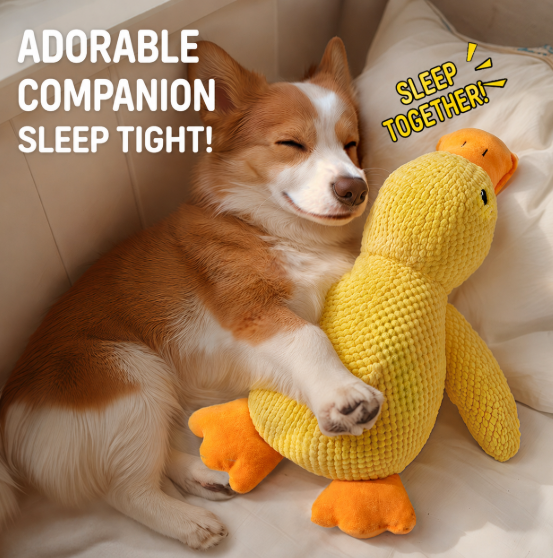
Small size band, 10–20 cm, short plush shell — the format most used for puppy teething and companionship programmes.
Step-by-Step: Specifying a Chew-Resistant Custom Plush Toy
The sequence below turns the variables above into an orderable specification. It assumes an OEM, ODM or private label project, which is the standard production mode for this category.
- Fix the weight band. Choose from <5 kg, 5–15 kg, or 15–30 kg based on the dog population the SKU will serve. This decision drives everything downstream.
- Assign the chew resistance level. Select Light Chewer, Moderate Chewer, or Aggressive Chewer and record it on the product record, not only in the brief.
- Select the size band and confirm the dimension range. 10–15 cm or 15–20 cm for small, 20–30 cm for medium, 30–50 cm for large. Confirm that the chosen dimension is reachable within the target cost and the intended retail format.
- Choose the shell material consistent with the band. Short plush, Oxford fabric, or food-grade TPR. If the design pulls against the default material for that band, say so explicitly in the brief rather than assuming the substitution.
- Write the construction requirements. Reinforced stitching technology, no-stuffing build where the design allows it, squeaker type, and whether a removable washable cover is required.
- Attach the compliance references. EN71, CPSIA, and GB/T 43839-2024, plus the material declarations confirming lead-free and phthalate-free status.
- Validate at sample stage. Sample lead time is 7–15 days. Test the seam and the shell against the intended chewer category before approving the bulk order, and confirm the ISO 9001 quality management system documentation covers the production scope.
Customization at specification stage covers logo printing, fabric material, size, color, stuffing type, squeaker type, packaging (box, blister or card), and hang tags — so the decisions in steps 3 to 5 can be adjusted without changing the product concept.
Compliance Reference for Chew-Resistant Plush Pet Toys
Compliance in this category is a set of documents rather than a single certificate. The table below sets out what each reference answers and where it sits in the current documentation.
| Reference | Market / scope | What it addresses | Status in the current documentation |
|---|---|---|---|
| EN71 | European market | Toy safety requirements for the European market | Products comply with EN71 |
| CPSIA | United States | US consumer product safety requirements for children's products and materials | Products comply with CPSIA |
| GB/T 43839-2024 | China | Safety Technical Requirements for Companion Animal (Pet) Products | Products comply; cited as the safety standard on the product model |
| ASTM F963 | United States | Toy safety standard; applied voluntarily to pet toys, which fall outside mandatory CPSC jurisdiction | Voluntary reference; confirm applicability per programme |
| ISO 9001 QMS | Global | Quality management system for the production of cloth/plush toys | Certified; certificate no. 00124Q35906R5M/3400, standard GB/T19001-2016, issued by CQC |
Compliance references as documented for the custom plush pet toy range. ASTM F963 status reflects the voluntary application described by Newtoppets (2026).
The quality management certificate is worth reading closely, because it is the document that tells a buyer where the quality system stops. Certification number 00124Q35906R5M/3400 applies to the production of cloth/plush toys under the GB/T19001-2016 standard and was issued by the China Quality Certification Centre (CQC). It is a system certification, not a product test report — which is why EN71, CPSIA and GB/T 43839-2024 still have to be cited separately on the order.
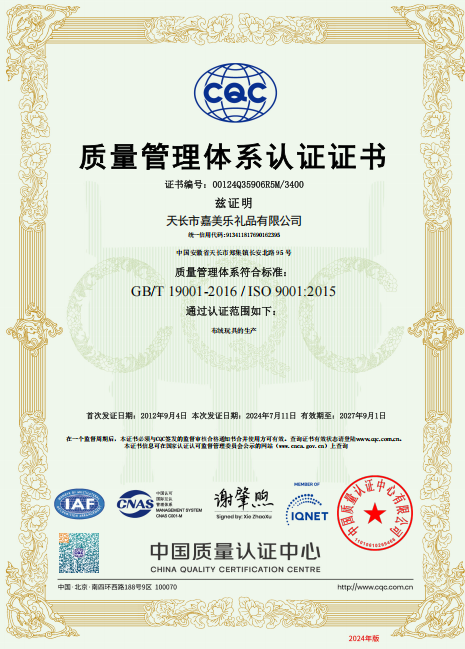
ISO 9001 QMS certificate no. 00124Q35906R5M/3400, issued by CQC, covering the production of cloth and plush toys.
Where Chew-Resistant Plush Toys Are Used
Chew resistance is not a single use case; it is a property that determines which use cases a product can serve without being replaced early. The range is used for daily pet companionship, separation anxiety relief, puppy teething training, indoor interactive play, outdoor fetch training, behavioural training support, and sleep comfort and calming.
Each use case applies a different load to the toy, and that load maps back to the specification:
- Puppy teething training — the highest-frequency chewing use case. This is where the chew resistance level and the TPR teething components matter most, and where a short plush build with reinforced stitching is most often specified.
- Separation anxiety relief and calming — load is sustained rather than intense. A squeaker device and a washable design matter more here than a heavy shell, because the toy is used for long periods and needs to be cleaned regularly.
- Interactive play and fetch training — load is intermittent but involves impact and retrieval. Size band selection does most of the work, because a toy that is too small for the dog will be over-compressed during tug and fetch.
- Behavioural training support and destructive-behaviour reduction — the toy has to remain intact long enough for the behaviour substitution to work, which is precisely where the 12–24 month service life figure becomes commercially relevant rather than technical.
On the buyer side, these use cases map to programmes run by pet brands and private label brands, pet wholesalers and distributors, cross-border e-commerce sellers, retail chains and supermarkets, and pet subscription box companies across markets including North America, Europe, Japan, South Korea and Australia.
Frequently Asked Questions
Do reinforced chew-resistant custom plush pet toys meet EN71, CPSIA, and GB/T 43839-2024?
Yes. The products comply with the international safety standards EN71 and CPSIA as well as the Chinese safety standard GB/T 43839-2024, Safety Technical Requirements for Companion Animal (Pet) Products. Materials used — food-grade TPR, short plush, and Oxford fabric — are lead-free and phthalate-free. Separately, the range is certified to the ISO 9001 quality management system under certificate no. 00124Q35906R5M/3400, standard GB/T19001-2016, issued by CQC and applicable to the global market, with a scope covering the production of cloth and plush toys.
Can the chew resistance level, shell material, and size band be specified separately?
Yes. Model designations include the dog weight options (<5 kg, 5–15 kg, 15–30 kg), the chew resistance level (Light Chewer, Moderate Chewer, Aggressive Chewer), the safety standard GB/T 43839-2024, and the material specification. The size band carries its own dimension range and shell material: 10–15 cm and 15–20 cm in short plush, 20–30 cm in Oxford fabric, and 30–50 cm in TPR. Customization covers fabric material, size, color, stuffing type, squeaker type, logo printing, packaging and hang tags.
What order quantities apply to a custom chew-resistant plush toy programme?
Minimum order quantities are typically 500–3,000 pieces per style, with complex custom designs often requiring 3,000–5,000 pieces. Project sizes in practice range from small pilot orders of 500–3,000 pieces and mid-scale e-commerce or retail orders of 3,000–20,000 pieces, up to large-scale long-term supply projects of 20,000–100,000+ pieces. Budget planning should treat the reinforcement level and the shell material as the two variables most likely to move unit cost.
How long does a sample take before a bulk order can be placed?
Sample lead time is 7–15 days. Sampling is the correct stage to validate the seam plan and the shell material against the intended chewer category, because reinforced stitching is a construction requirement that is verifiable on a physical sample but not on a fabric description. Approving a sample without testing it against the target weight band is the most common cause of a specification that later underperforms.
What is the bulk lead time, and how is quality controlled during production?
Bulk production runs 20–45 days depending on complexity and volume. Quality control follows a three-stage structure: IQC incoming inspection, IPQC in-process inspection, and OQC final inspection, with third-party inspections such as SGS or BV often required by buyers. After-sales support includes replacement or rework for quality issues, inspection reports, spare units of 1–3% in some programmes, and replacement negotiation support. To start a specification, send the target weight band, chew resistance level, size band and destination market to winnie@jml-toys.com or WhatsApp +86 173-7538-5845.
Conclusion
Chew resistance in custom plush pet toys is built from three decisions taken before production: the stitch plan, the shell material, and the geometry of the toy against the dog's weight band. Reinforced stitching controls whether the seam holds. Food-grade TPR, short plush, and Oxford fabric determine how the shell responds to load and which size band it suits. Dimensions determine whether the toy is loaded the way it was designed to be.
Get all three right and the reinforced chew-resistant series delivers its stated 12–24 month average service life, with non-toxic, lead-free and phthalate-free materials meeting EN71, CPSIA and GB/T 43839-2024. Get them out of sequence and the same materials produce a toy that fails at the seam within weeks. The specification, not the fabric, is the deciding document.

Request a chew-resistance specification and sample plan
Send your target weight band, chew resistance level, size band and destination market. Tianchang Jiameile Gifts Co., Ltd. supplies custom plush pet toys under OEM, ODM and private label projects, with reinforced stitching, food-grade materials and documented compliance to EN71, CPSIA and GB/T 43839-2024. Samples: 7–15 days. Bulk production: 20–45 days.
Email: winnie@jml-toys.com | WhatsApp: +86 173-7538-5845 | Blog: blog.jiameiletoys.com
Have Questions or Need More Details?
Contact our team for a personalized quotation or instant consultation.
Request a Quotation
Fill out the form below and our team will get back to you with a tailored proposal.
WhatsApp Direct Chat
Prefer to chat in real-time? Message us on WhatsApp for instant assistance & quick answers.
- Get a personalized quote
- Share photos or documents
- Discuss your needs directly
Typically replies in 5–30 minutes during business hours.