Custom Plush Pet Toys: Planogram vs E-Commerce Bundle Guide
One Custom Plush Pet Toy line can serve a retail planogram and an e-commerce bundle at the same time, but only when the shared product core is fixed before the channel variables are set. The core covers materials, stitching, safety compliance and the basic toy shape. The channel variables cover size emphasis, chewer-level mix, module selection, packaging and bundle architecture.
This application guide is written for pet retail chains, pet brands, private-label buyers and cross-border e-commerce sellers. It maps the size bands from 10–15 cm to 30–50 cm, the dog weight groups under 5 kg, 5–15 kg and 15–30 kg within an overall 5–40 kg fit, and the Light, Moderate and Aggressive chewer levels. It then connects those choices to short plush, Oxford fabric and food-grade TPR, to EN71, CPSIA and GB/T 43839-2024 compliance, and to OEM/ODM support for squeaker and heartbeat module integration.
Jiameile (Tianchang Jiameile Gifts Co., Ltd) is a plush and textile toy manufacturer based in Tianchang, Anhui Province, China. The company produces pet toys alongside other plush lines, exports to the EU and USA markets, and lists certifications including ICTI, BSCI, Disney FAMA, ISO 9001 and ISO 14001. Its profile also records authorized production of mascots and related products for events including UEFA Euro 2016, FIFA World Cup 2018, FIFA Women's World Cup 2019, UEFA Euro 2020, FIFA World Cup 2022 and the Hangzhou Asian Games 2023.
Why One Toy Line Needs Two Configurations
A shelf planogram and an e-commerce bundle are two different buying moments. On a shelf, a shopper compares size, surface, price and function in seconds, so packaging has to stand, hang or stack and communicate at a glance. Online, the shopper judges from a main image, title, bundle count and detail-page text, and cannot touch the product. The listing has to replace the hand test with scale references, material descriptions and care instructions.
Those moments pull the same product line in different directions. A planogram needs width: several sizes and one or two chewer levels so the shelf covers the category without becoming a wall of similar SKUs. A bundle needs depth: fewer core items, more pieces per order, and a theme that justifies the set. Configuring two separate product lines solves the channel problem but creates a bigger one — duplicate tooling, duplicate testing, duplicate packaging and a replenishment plan that splits inventory. The alternative is a single line with a locked core and channel-specific outer layers.
The category supports that approach. Custom Market Insights estimates that plush and soft toys account for approximately 30% of the dog toys market (2026), and Fortune Business Insights valued the global pet toys market at USD 9.60 billion in 2025. Plush is a mainstream format rather than a niche, which means most retail and e-commerce assortments already have room for one more well-configured line.
Defining the Shared Product Core
The shared core is the set of requirements that does not change between the shelf and the bundle. In the supplied application-scenario data, those requirements are non-toxic eco-friendly materials, EN71 and CPSIA compliance, chew-resistant and tear-resistant construction, reinforced stitching, a washable design and a no-stuffing option for safety. The same data lists OEM/ODM customization support as part of the scope.
Compliance belongs in the core, not at the end of the project. The product specification in this guide lists GB/T 43839-2024, Safety Technical Requirements for Companion Animal (Pet) Products, while EN71 and CPSIA appear in the small-size product scope and in the application-scenario requirements. Jiameile's company profile also lists EN71, ASTM F963 and GB6675 for its toy production, together with the social-compliance and quality-management certifications noted above. Keeping one compliance file per material and construction is simpler than running separate files for a shelf version and an online version of the same toy.
OEM/ODM customization is where the channel variables live. The supplied capability data lists logo printing, fabric material, size, color, stuffing type, squeaker type, packaging and hang tags as the customization fields. Those fields are enough to build a planogram version and a bundle version from one core toy without changing the construction that was tested.
Mapping Size Bands to Shelf Space and Parcel Economics
The line uses four size bands: 10–15 cm and 15–20 cm in short plush, 20–30 cm in Oxford fabric, and 30–50 cm in food-grade TPR. The weight groups run under 5 kg, 5–15 kg and 15–30 kg, while the small-size product scope describes suitability for dogs from 5–40 kg. The size band is therefore not just a measurement; it is the first allocation decision between shelf space, parcel weight and price tier.
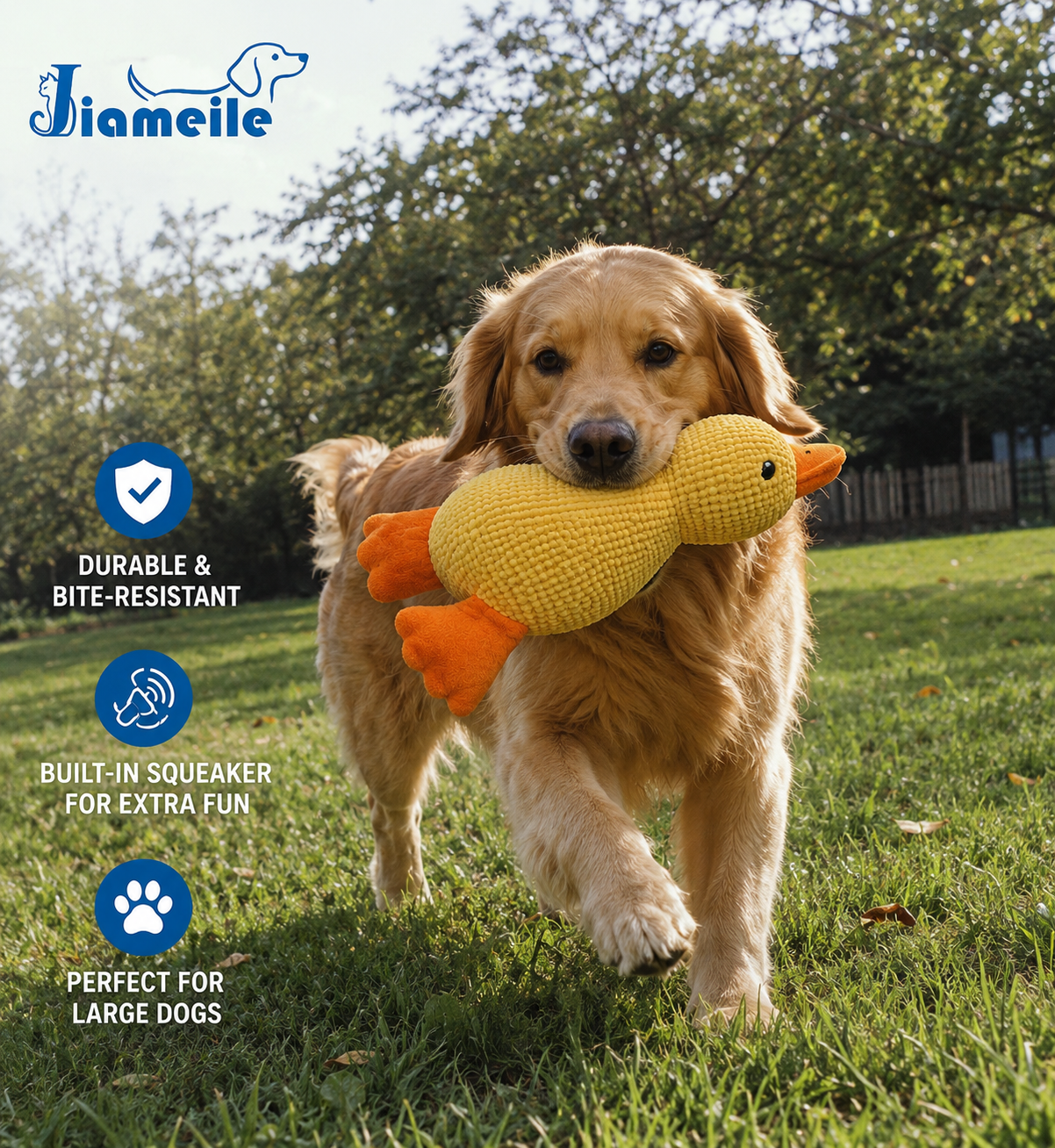
Short plush construction is used in the 10–15 cm and 15–20 cm size bands.
On a planogram, the 10–15 cm and 15–20 cm short plush items usually take the smallest facing. They suit hook or small-box formats, impulse positions and puppy or small-dog sections. The 20–30 cm Oxford item is the natural middle facing for the 5–15 kg group, and the 30–50 cm TPR item needs a lower shelf, a floor position or a larger box. A useful shelf rule is one size band per facing group, with the material and chewer level printed on the front rather than left to the shopper to guess.
In an e-commerce bundle, the same bands become set components. A small-plus-medium set keeps parcel weight manageable and gives the buyer two textures; a medium-plus-large set reads as a durability purchase; a three-size set needs a scale reference in the main image because the shopper cannot judge 10–15 cm against 30–50 cm without help. The product dimension is not the same as the packed dimension, so the retail or parcel size should be checked against the actual card, box or mailer before the planogram is finalized. For cross-border sellers, the small and medium bands usually carry the lower shipping cost per unit, while the 30–50 cm TPR item works better as a single-item hero or as the high-value component of a larger set.
Assigning Weight Groups and Chewer Levels
The line is specified for three chewer levels — Light, Moderate and Aggressive — across the same size and weight structure. On a shelf, one or two chewer levels per size band is usually enough to keep the facing count controlled; color coding or a simple icon on the hang tag does the sorting work. In an e-commerce listing, the same levels can appear as variants under one product or as mixed-level sets, provided the weight group and chewer level are stated in the title and detail text.
The weight group sets the size floor, and the chewer level sets the construction ceiling. A dog under 5 kg can use a 10–15 cm short plush toy, but the same toy is not the right specification for an aggressive chewer in the 15–30 kg group. The supplied case data gives service-life ranges of 3–12 months for standard plush toys, 6–24 months for reinforced chew toys and 12–36 months for rubber and TPR toys, depending on usage intensity. Those ranges are useful for setting customer expectations and for choosing which SKU carries the durability message; they are not a guarantee for every dog or every household.
One point needs care when the shelf and the bundle share a core. The Light, Moderate and Aggressive levels are product specifications, and the material choice is one of the variables a buyer configures with the supplier. The supplied data lists short plush, Oxford fabric and food-grade TPR across the range, but it does not state that one material is reserved for one chewer level. The material-to-level mapping should be confirmed per SKU during sampling rather than assumed from the size band alone.
Choosing Short Plush, Oxford Fabric or Food-Grade TPR
Short plush is the soft-surface option used in the 10–15 cm and 15–20 cm bands. It fits daily companionship, puppy teething and comfort use, and the washable design in the shared core supports the hygiene story that retail and online buyers both ask about. Oxford fabric carries the 20–30 cm middle band, where a woven surface gives the product a different hand feel from the small plush items. Food-grade TPR carries the 30–50 cm band and is described in the product specification as lead-free and phthalate-free.
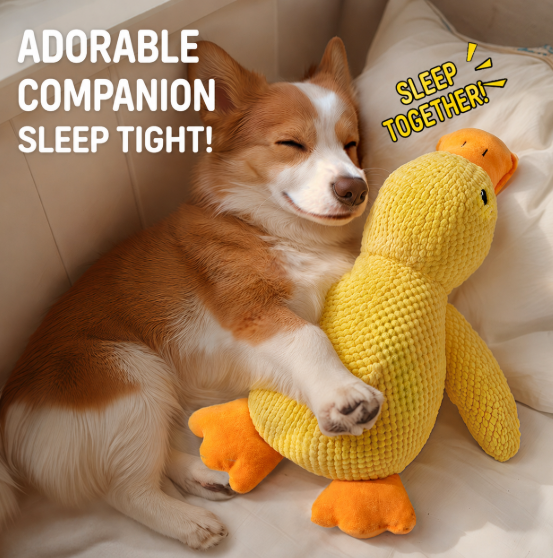
Food-grade TPR is used in the 30–50 cm large size band.
Material choice changes more than appearance. On a shelf, short plush invites touch and suits open display; a TPR item reads as a tougher product and can carry a higher price tier. Online, the material has to be described because the shopper cannot feel it, and the description should match the care instructions on the detail page. Consumer care guidance for plush dog toys generally recommends a gentle cold machine wash and air drying, with electronic components removed first (iHeartDogs, 2026; Jeffers Pet, 2024). That guidance is written for plush toys generally; the care label for a specific SKU should reflect its actual material, stitching and module.
For a mixed bundle, the material mix is part of the value proposition: a short plush comfort item, an Oxford fabric middle item and a TPR durable item give the buyer three textures and three use cases in one order. For a planogram, the same logic works vertically — plush at eye level for small dogs, Oxford in the middle, TPR at the bottom for larger dogs — provided the retailer's fixture can carry the 30–50 cm item safely.
Compliance Configuration for Retail and Online Listings
Compliance is configured once and then documented per SKU. The product specification lists GB/T 43839-2024 for the range, and EN71 and CPSIA appear in the small-size scope and the application-scenario requirements. The company profile adds EN71, ASTM F963 and GB6675, together with ICTI, BSCI, Disney FAMA, ISO 9001 and ISO 14001. Those are company-stated certifications in the supplied profile; buyers should request the current certificate and the test report that matches the specific material, color and construction they are ordering.
The US market needs a specific note. A secondary industry source states that pet toys fall outside mandatory CPSC jurisdiction in the United States and that ASTM F963 is voluntarily applied (Newtoppets, 2026). That does not make testing optional for a retail chain or a marketplace listing; it means the buyer should confirm the actual test scope with the supplier instead of assuming that toy regulation applies automatically to a pet product. The practical approach is to treat EN71, CPSIA and GB/T 43839-2024 as the shared base, then add the destination-market requirements that the retailer or platform actually asks for.
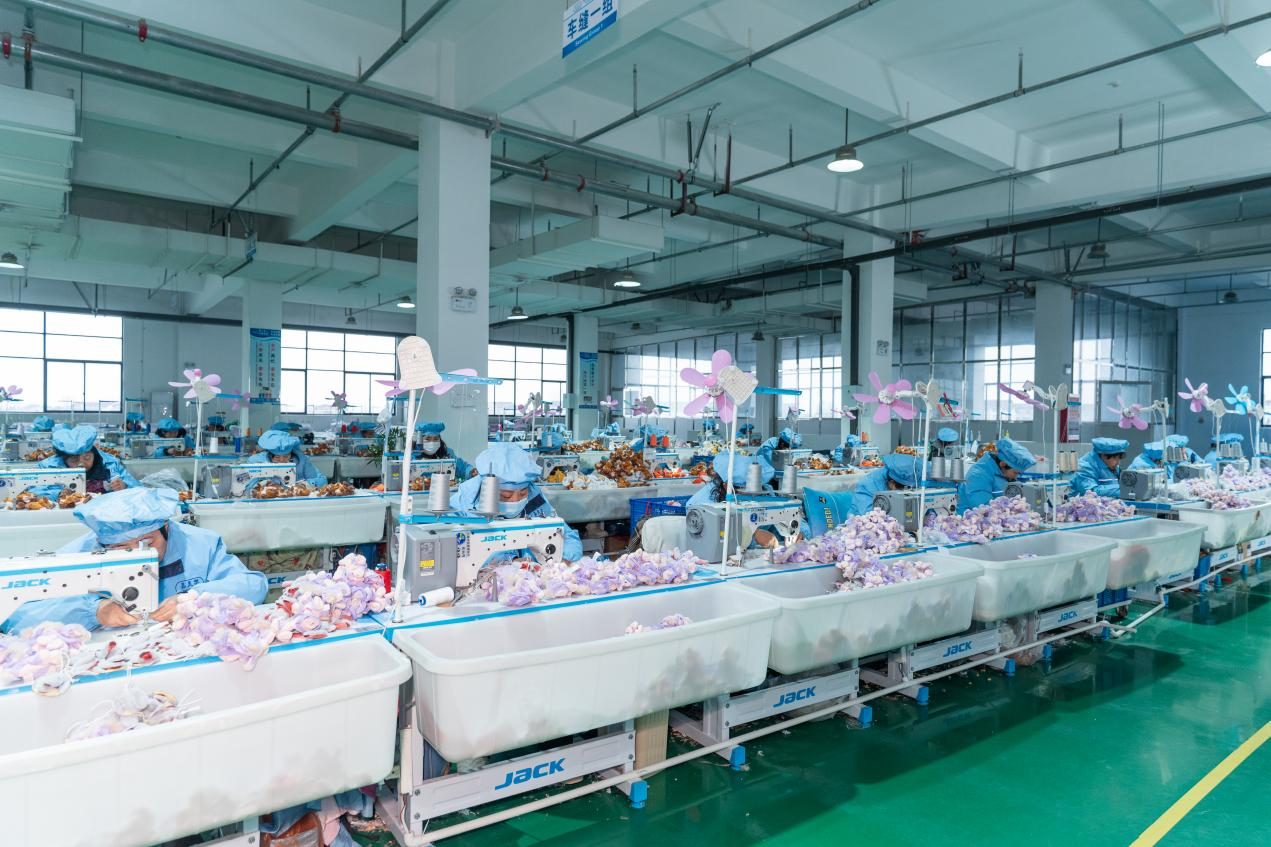
Factory production area supporting custom plush pet toy programs.
Retail chains usually want compliance documents with the shipment, and the capability data notes that third-party inspections by SGS or BV are often required. E-commerce sellers need the same documents plus listing-ready statements that match the detail page. One test report should not be stretched across a whole line if the materials or colors differ; the safer configuration is a document set that follows the SKU matrix.
Integrating Squeakers and Heartbeat Modules by Channel
Squeaker devices and heartbeat modules are the two interactive options named in the application-scenario data, which states that the product requires supporting equipment such as a squeaker device and a heartbeat module. The same data lists squeaky interactive mode and comfort companion mode as operation modes, and separation anxiety relief and sleep comfort as working conditions. Those two modules serve different jobs: the squeaker supports active play and attention, while the heartbeat module supports calming and companionship.
On a planogram, the squeaker is the easier sell because the shopper can press or squeeze the toy and hear the result. The heartbeat module needs explanation, battery care and a closed box or a staff-assisted display, so it usually works better as a featured item than as an open-bin product. Online, both modules can be demonstrated in video, and a bundle can separate the interactive item from the calming item so the shopper understands why there are two toys in the set.
The application-scenario data also lists a rope structure, TPR teething components, a removable washable cover and an anti-slip bottom design as matched equipment. These are configuration options rather than default inclusions. A removable cover makes washing easier; a TPR teething component adds a puppy use case; a rope structure changes the play pattern. Each addition should be justified by the channel and the target weight group, not added to every SKU. Electronic parts should be removed before washing, which is why the care label and the removable-cover option belong in the same packaging decision.
Packaging, Labeling and Bundle Architecture
Packaging is the clearest point where the two channels diverge. The customization scope includes packaging in box, blister or card format, plus hang tags. A blister or card supports hook display and shows the product surface; a box supports shelf stacking and carries more copy; a hang tag can hold the size band, weight group, chewer level, material and care icons. For the planogram, the front panel should answer three questions without a staff member: what size is it, which dog weight is it for, and how tough is it.
For the e-commerce bundle, the unit of sale is the set, not the single toy. That means a bundle carton or mailer, an individual care insert, a main image with a scale reference, and a detail page that explains what each piece is for. The bundle SKU should be planned as its own style for MOQ purposes, because the packaging and the assortment differ from the shelf version even when the toys inside are the same. The capability data gives a typical MOQ of 500–3,000 pieces per style, with complex custom designs often at 3,000–5,000 pieces, so splitting the order into a shelf style and a bundle style is a quantity decision as well as a design decision.
Labeling should stay consistent across channels. The same product name, size band and chewer level should appear on the hang tag, the carton and the listing, otherwise the retailer and the online seller end up describing the same toy in two different ways. Barcodes, warnings and care text are part of the packaging brief, not an afterthought once the toy is approved.
Step-by-Step Configuration Workflow
- Lock the shared core. Confirm non-toxic eco-friendly materials, reinforced stitching, chew-resistant and tear-resistant construction, the no-stuffing option where required, the washable design and the compliance set.
- Build the size ladder. Assign 10–15 cm and 15–20 cm to short plush, 20–30 cm to Oxford fabric and 30–50 cm to food-grade TPR.
- Assign weight groups and chewer levels. Map the under-5 kg, 5–15 kg and 15–30 kg groups to the size bands, then set Light, Moderate and Aggressive levels per SKU.
- Select modules. Choose squeaker, heartbeat, rope, TPR teething component or removable cover by use case, not by default.
- Design channel packaging. Use card, blister, box and hang tag for the shelf; use a bundle carton, care insert and scale-referenced main image for e-commerce.
- Confirm compliance documents per SKU. Match EN71, CPSIA and GB/T 43839-2024 files to the actual material and color, and add destination-market requirements.
- Sample and validate. The capability data gives a 7–15 day sample lead time; check size against the fixture or bundle plan, surface, stitching, module function, packaging fit and label copy.
- Plan bulk production. Bulk lead time is typically 20–45 days depending on complexity and volume.
- Set the order scale. Project sizes are commonly 500–3,000 pieces for a pilot, 3,000–20,000 pieces for mid-scale retail or e-commerce orders, and 20,000–100,000+ pieces for long-term supply.
- Prepare care and after-sales content. Finalize washing instructions, spare-unit terms and the replacement or rework process before launch.
Use Cases: Three Channel Configurations
Retail chain end-cap set
A four-facing end-cap can combine a 10–15 cm short plush carded item, a 20–30 cm Oxford boxed item, a 30–50 cm TPR floor item and one squeaker interactive item. The set covers the under-5 kg, 5–15 kg and 15–30 kg groups, uses one compliance file per material, and gives the shopper a clear size and toughness ladder. The exact facing count depends on the retailer's fixture, so the packed dimensions should be checked before the planogram is locked.
E-commerce starter bundle
A starter bundle can pair a small short plush comfort toy, a small TPR teething component and a heartbeat comfort module. The listing needs a scale reference, a clear statement that the heartbeat module is a calming item rather than a chew item, and care instructions that explain how to remove the electronic part before washing. The bundle works as an entry price point and introduces two or three use cases in one order.
Cross-border and subscription configuration
A cross-border or subscription seller can build around the small and medium bands to control parcel weight, then rotate color and theme each cycle while keeping the core construction unchanged. The 30–50 cm TPR item can be held as a separate hero SKU rather than forced into every box. Jiameile's case data reports a repeat purchase rate above 85%, with some long-term clients purchasing more than 100,000 pieces annually; those are company-reported figures and should be read as program experience, not a forecast for a new seller.
These are configuration examples built from the supplied product, capability and application data. They are not descriptions of completed customer projects, and each one should be validated against the retailer's fixture, the destination market's test requirements and a physical sample.
Comparison Table: Planogram vs E-Commerce Bundle
The table compares the two channel configurations on the dimensions that change most often. Typical order and lead-time ranges come from the supplied capability data and should be confirmed per style and destination.
| Configuration dimension | Retail planogram | E-commerce bundle |
|---|---|---|
| Primary decision moment | In-store comparison of size, surface and price | Main image, bundle contents and detail-page text |
| Size emphasis | 10–15 cm and 15–20 cm carded; 20–30 cm boxed; 30–50 cm lower shelf or floor | Multi-size sets across 10–50 cm with a scale reference |
| Material by band | Short plush (small), Oxford fabric (medium), food-grade TPR (large) | Same core materials, mixed by bundle theme |
| Chewer level | One or two levels per facing to control SKU width | Variants or mixed-level sets with clear labels |
| Module choice | Squeaker for try-me appeal; heartbeat where staff can explain use | Squeaker and heartbeat shown in video and copy |
| Packaging | Blister, card, hang tag or box | Bundle carton plus individual care insert |
| Compliance documents | EN71, CPSIA and GB/T 43839-2024 files per SKU | Same files plus listing-ready statements |
| Care information | On-pack icons and short washing text | Detail-page washing and electronics-removal instructions |
| Typical order scale | 500–3,000 pcs pilot; 3,000–20,000 pcs mid-scale | Same scale, quoted per bundle style |
| Sampling and bulk lead time | 7–15 days sample; 20–45 days bulk | 7–15 days sample; 20–45 days bulk |
FAQ
Which safety standards apply to custom plush pet toys sold through retail and e-commerce?
The product specification in this guide lists GB/T 43839-2024, Safety Technical Requirements for Companion Animal (Pet) Products, while EN71 and CPSIA appear in the small-size product scope and the application-scenario requirements. Jiameile's company profile also lists EN71, ASTM F963 and GB6675, together with ICTI, BSCI, Disney FAMA, ISO 9001 and ISO 14001. A US-focused secondary source notes that pet toys fall outside mandatory CPSC jurisdiction and that ASTM F963 is voluntarily applied, so the buyer should confirm the actual test scope per SKU rather than assume automatic toy regulation.
Can one custom plush pet toy line serve both a shelf planogram and an online bundle?
Yes, when the shared core is locked before the channel variables are set. The core covers non-toxic eco-friendly materials, reinforced stitching, chew-resistant and tear-resistant construction, washable design and the compliance set. The channel variables cover size emphasis from 10–15 cm to 30–50 cm, chewer-level mix, material surface, squeaker or heartbeat modules, packaging and bundle architecture. OEM/ODM customization covers logo printing, fabric, size, color, stuffing type, squeaker type, packaging and hang tags, which is enough to build both versions from one core toy.
What MOQ should a retail chain or e-commerce seller plan for?
The supplied capability data gives a typical MOQ of 500–3,000 pieces per style, with complex custom designs often at 3,000–5,000 pieces. Project sizes are commonly described as 500–3,000 pieces for a pilot, 3,000–20,000 pieces for mid-scale retail or e-commerce orders, and 20,000–100,000+ pieces for long-term supply. A planogram set and a bundle set are separate styles for MOQ purposes, so the combined quantity should be planned before the quote is finalized.
How long does sampling take before a planogram or bundle launch?
Sample lead time is typically 7–15 days. The sample should be checked for size against the shelf or bundle plan, surface material, stitching, squeaker or heartbeat function, packaging fit and label content. Because the same core serves both channels, one sample round can cover the shelf version and the bundle version when the packaging artwork is reviewed together.
What bulk lead time and after-sales support should buyers expect?
Bulk production is typically 20–45 days depending on complexity and volume. After-sales support in the capability data includes replacement or rework for quality issues, inspection reports and 1–3% spare units where agreed. Jiameile's case data reports a repeat purchase rate above 85%, with some long-term clients purchasing more than 100,000 pieces annually; these are company-reported figures, not a guarantee for every program. Buyers comparing a planogram set with a bundle set can request a sample and configuration review from Jiameile at winnie@jml-toys.com.
Conclusion
Adapting one Custom Plush Pet Toy line to retail planograms and e-commerce bundles is a configuration problem before it is a design problem. The shelf version needs a clear size ladder, one or two chewer levels per facing and packaging that answers the size, weight and toughness questions at a glance. The bundle version needs a scale-referenced main image, a set architecture that mixes sizes or modules with a purpose, and a detail page that carries the care and compliance information the shopper cannot get by touch.
The shared core makes both versions possible: non-toxic eco-friendly materials, reinforced stitching, chew-resistant and tear-resistant construction, washable design and the EN71, CPSIA and GB/T 43839-2024 documentation set. The channel variables — 10–15 cm to 30–50 cm size emphasis, under-5 kg to 15–30 kg weight groups within the 5–40 kg scope, Light, Moderate and Aggressive chewer levels, short plush, Oxford fabric and food-grade TPR, squeaker and heartbeat modules, and packaging format — are decisions that can be made once and reused across the line. A practical next step is to take the retailer's fixture dimensions and the seller's bundle plan into one sampling round: confirm the shared core, check the 7–15 day sample against both channel formats, and agree the 20–45 day bulk schedule before the first planogram or listing goes live.
Have Questions or Need More Details?
Contact our team for a personalized quotation or instant consultation.
Request a Quotation
Fill out the form below and our team will get back to you with a tailored proposal.
WhatsApp Direct Chat
Prefer to chat in real-time? Message us on WhatsApp for instant assistance & quick answers.
- Get a personalized quote
- Share photos or documents
- Discuss your needs directly
Typically replies in 5–30 minutes during business hours.