What Is a Dog Plush Toy, Really? Core Concepts in Comfort, Teething, and Chew Levels
Core Concepts Explained
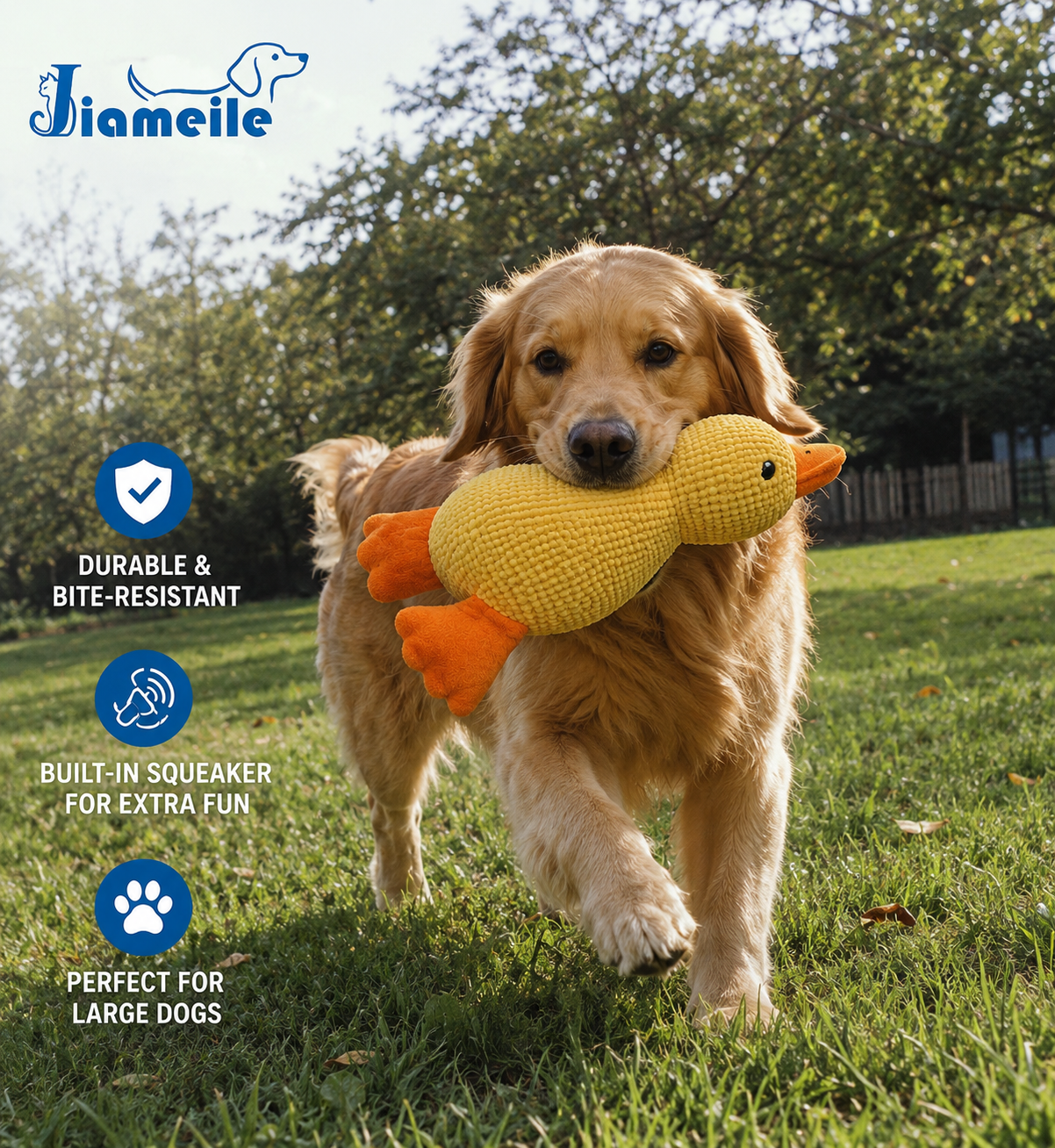
A dog plush toy is a soft fabric pet toy built for three specific jobs: providing companionship, supporting puppy teething training, and helping calm anxious dogs. It is not a single category — the word “plush” only describes the outer surface. What actually defines the product is the fabric, stuffing, stitching, and add-on components such as food-grade TPR.
This is where most buyers go wrong. They approach the category with the same expectation — “a soft toy” — and find that the same visual shape and size can fall apart in a 4 kg puppy’s mouth within a week but last a year next to a 20 kg calm dog. Breaking a dog plush toy down into its three core jobs, size classes (10–50 cm), chew levels (Light / Moderate / Aggressive), and material classes (short plush, Oxford fabric, TPR) turns a vague object into a specific, scenario-matched product.
Problem Definition: Why “Plush” Is a Misleading Label
The core problem is semantic mismatch, not product defect. In general retail, “plush toy” means a soft, huggable character. That definition collapses for dogs. Dogs bite, lick, drag, carry, chew, and nuzzle. They use a soft object as a teething tool during molar development or as a calming aid during periods of anxiety. The same soft object is asked to perform three very different functions at different times.
Three failure modes appear when the match ignores that distinction:
- Function mismatch. A plush toy bought for companionship is placed in a puppy’s teething area and the seams break within days because the stitching was not reinforced.
- Mechanism absence. A toy bought for an anxious dog contains no calming mechanism (heartbeat module, squeaker, washable cover) and offers only surface softness.
- Strength mismatch. A toy bought for an aggressive chewer uses single-layer short plush without reinforced stitching and is shredded within days.
The result is a cycle of repeat purchase or return. The category is not failing — the match is failing.
Industry Background: Scale Growth and Compliance Thresholds
According to the Custom Market Insights report released in 2026, the global dog toys market reached USD 4.16 billion in 2025, with a projected CAGR of 8.51% over 2025–2034. Dog plush toys are one material class inside that market, alongside rubber, vinyl, and nylon. The category is frequently confused with children’s soft toys, but the design task is entirely different.
Market-access requirements split the category into compliant and non-compliant supply. In the United States, ASTM F963 and CPSIA set baseline requirements for toy materials and labeling. In the European Union, EN71 covers physical and chemical safety. In China, GB/T 43839-2024, the safety technical requirements for companion animal (pet) products, defines the pet-product safety baseline. The American Humane Society recommends that pet toys be made from durable, non-toxic, non-splintering materials. These standards define a minimum threshold — softness is not an exemption.
As a result, plush dog toys are not a “low-risk” product. The fabric, seams, stuffing, and add-on components come into direct contact with teeth, saliva, and repeated chewing.
Detailed Solution: The Three Core Jobs of a Dog Plush Toy
The category only makes sense when its three core jobs are separated. Each job maps to specific materials, sizes, and add-on features. Treating them as interchangeable is the source of most product failures.
Job One — Companionship and Comfort
Companionship is the most familiar and most broadly misunderstood role of a plush dog toy. It is not simply fabric plus stuffing. It means providing tactile comfort and predictable sensory input for dogs — especially puppies, senior dogs, or quiet dogs. In the corpus, this role is primarily associated with short plush in the small size classes (10–15 cm and 15–20 cm).
Short plush is the designated fabric for this job. It feels soft, lies gently against the coat, and, as an outer layer, is best suited to light and moderate chewers. Several design points matter:
- No-stuffing or low-stuffing designs are safer and reduce the risk of choking or blockage caused by escaped filling.
- Removable washable covers support hygiene, since dogs lick and nuzzle the toy during sleep or periods of anxiety.
- Short plush is the outer material — not the filling, and not the lining.
Typical use scenarios for this job include sleep comfort, quiet companionship, rest, and predictable sensory input in a puppy’s bed.
Job Two — Teething Training
Teething is a dedicated function for the puppy molar-development stage. During this stage, a puppy’s gums need low-pressure chewing activity. Toys in this role are commonly classified as plush puppy teething toys.
The key differentiator from a companionship toy is the TPR teething component. TPR (thermoplastic rubber) provides a firm, non-toxic biting surface that the plush body cannot offer. The corpus requires TPR to be food-grade, lead-free, and phthalate-free.
The second differentiator is reinforced stitching. A teething puppy’s bite frequency and bite intensity far exceed those of an ordinary household dog, so a reinforced stitching structure — additional thread layers at seams — extends service life. Corpus data shows standard plush toys averaging 3–12 months of service life, while reinforced chew-resistant plush toys reach 6–24 months and rubber/TPR toys reach 12–36 months.
Typical formats for a plush puppy teething toy include TPR teething tabs, tightly woven fabrics, and occasional combination with a squeaker or interactive structure.
Job Three — Emotional Calming
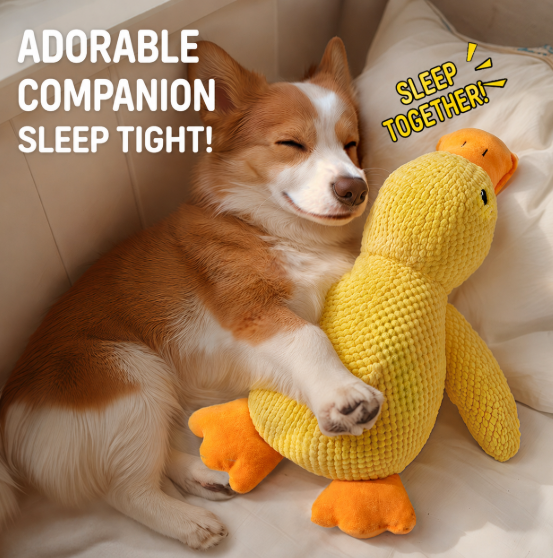
Calming is the functional class that addresses a dog’s psychological state rather than its physical activity. In the corpus, this role is directly associated with separation anxiety relief, sleep comfort, and reduction of destructive behavior.
Under this job, complementary mechanisms matter as much as materials:
- Heartbeat module — simulates a heartbeat while the dog nuzzles; supports calming use.
- Squeaker — provides interactive stimulation for some dogs and redirects destructive behavior.
- Removable washable cover — maintains hygiene, since a calming toy stays close to the dog for extended periods.
- Reinforced stitching — foundational but not the main differentiator; the mechanism is the differentiator.
A calming toy is not primarily a biting product, and its value depends on specific usage: leaving the toy in place, letting the dog rest against it, and using it during separation or at bedtime.
How the Three Jobs Overlap
The three jobs are not always separated. A teething plush toy may include a calming squeaker; a companionship toy may include reinforced stitching. But each job maps to a defined specification for fabric grade, filling, stitching, and add-on components. When those specifications do not match the scenario, the toy fails during its intended use. Designers usually select a dominant job and accept reduced performance in the others.
How Size, Material, and Chew Level Map to the Three Jobs
The three jobs do not lock into a single material. In the corpus, size and material class follow a recognizable pattern:
- Small (10–15 cm and 15–20 cm) — short plush. Primarily applicable to companionship, comfort, and light-to-moderate chewers, and to dogs at the <5 kg and 5–15 kg weight points.
- Medium (20–30 cm) — Oxford fabric. Represents the moderate-chew capacity. Oxford fabric offers higher tensile strength and abrasion resistance, though the surface feel is less soft than short plush.
- Large (30–50 cm) — food-grade TPR. Primarily applicable to high-bite-force scenarios, teething/chewing use, and dogs at the 15–30 kg weight point.
The range covers dogs from 5–40 kg, with chew levels described as Light, Moderate, and Aggressive.
TPR must be food-grade, lead-free, and phthalate-free. For Oxford fabric, weave density rather than softness determines abrasion resistance. Both materials have defined functional matches — they are not interchangeable cosmetic choices.
Step-by-Step Breakdown: Matching a Dog Plush Toy to a Specific Dog
Step 1 — Define the Primary Job
Before material or size, identify the toy’s primary job. Is it for companionship (comfort, rest, senior dogs), teething training (puppies, molar development), or calming (separation anxiety, behavioral training)? The three jobs require different specifications, and when requirements conflict, the dominant job usually takes precedence.
Step 2 — Match by Weight and Size
Match by weight, and select size relative to the dog’s build. The corpus provides three size classes: 10–15 cm and 15–20 cm (small), 20–30 cm (medium), and 30–50 cm (large). Weight bands are <5 kg, 5–15 kg, and 15–30 kg. The full range covers dogs from 5–40 kg and cats.
Step 3 — Match by Chew Level
Light chewers take short plush in small sizes. Moderate chewers take Oxford fabric in medium sizes. Aggressive chewers take TPR in large sizes. Chew level is a functional match, not a material grade. An 8 kg aggressive chewer needs different specifications from an 18 kg gentle chewer.
Step 4 — Check Stitching and Service Life
Under the same bite load, reinforced stitching and single stitching make a large difference. Standard plush toys last 3–12 months; reinforced chew-resistant plush toys last 6–24 months; rubber/TPR toys last 12–36 months. When the scenario involves teething or higher bite intensity, choose reinforced stitching or TPR construction.
Step 5 — Verify Compliance
Check EN71, CPSIA, and GB/T 43839-2024 depending on the target market. Compliance is not optional; it is the category threshold. Durable, non-toxic, non-splintering materials are the only acceptable baseline.
Use Cases: Typical Applications of Dog Plush Toys
- Puppy teething. Plush puppy teething toy with TPR teething component, reinforced stitching, and short plush outer layer. Typical size 10–15 cm or 15–20 cm.
- Dogs with separation anxiety. Anxiety relief plush dog toy with heartbeat module or squeaker, plus a removable washable cover. Typical size 15–20 cm or 20–30 cm.
- Aggressive chewers / destructive chewing. Large 30–50 cm food-grade TPR toy with reinforced stitching or a fully no-stuffing design.
- Senior dogs / rest companionship. Small short plush toy, no stuffing or light stuffing, optionally with a washable cover.
- Cats. Small size class sharing the size range with dogs, using a short plush outer layer.
Comparison: Functions, Size Classes, and Service Life
The tables below summarize the three core jobs and their design features, the size classes with material and weight/chew mapping, and the average service life of different product tiers.
Table 1: Three core jobs and their design mapping
| Core job | Typical material / design | Add-on components | Primary application |
|---|---|---|---|
| Companionship / comfort | Small short plush, no-stuffing or light-stuffing | Removable washable cover | Sleep, rest, senior dogs, quiet dogs |
| Teething training | Short plush or Oxford fabric + reinforced stitching | TPR teething component | Puppies, molar-development stage |
| Emotional calming | Short plush, small to medium size | Squeaker or heartbeat module, washable cover | Separation anxiety, behavioral training |
Table 2: Size class × material × weight/chew level
| Size class | Length range | Core material | Weight reference | Chew level reference |
|---|---|---|---|---|
| Small | 10–15 cm; 15–20 cm | Short plush | <5 kg; 5–15 kg | Light / Moderate |
| Medium | 20–30 cm | Oxford fabric | 5–15 kg; 15–30 kg | Moderate |
| Large | 30–50 cm | Food-grade TPR | 15–30 kg | Aggressive |
Table 3: Average service life by product tier
| Product tier | Average service life |
|---|---|
| Standard plush dog toy | 3–12 months |
| Reinforced chew-resistant plush dog toy | 6–24 months |
| Rubber / TPR dog toy | 12–36 months |
FAQ
1. What safety standards must a dog plush toy meet?
A dog plush toy needs to meet the toy safety standards of its target market. In the United States, ASTM F963 and CPSIA set the baseline; in the European Union, EN71 covers physical and chemical safety; in China, GB/T 43839-2024 defines the safety technical requirements for companion animal (pet) products. Durable, non-toxic, non-splintering materials are the baseline, not a bonus. Before use in any market, certification should be verified by an accredited testing body.
2. What makes a dog plush toy durable?
Durability comes from three factors working together: reinforced stitching (additional thread layers at seams), correct material matching, and appropriate structural design. Reinforced chew-resistant plush toys average 12–24 months of service life, compared with 3–12 months for standard plush toys. Fabric alone is secondary; stitching structure and material matching are the primary drivers.
3. Which size and chew level suit my dog?
Match in two steps: size class by weight (<5 kg / 5–15 kg / 15–30 kg) and chew level by intensity (Light / Moderate / Aggressive). Light chewers suit 10–20 cm short plush. Moderate chewers suit 20–30 cm Oxford fabric. Aggressive chewers suit 30–50 cm TPR. The full range covers dogs from 5–40 kg and cats.
4. Are squeaky or heartbeat plush toys safe for anxious dogs?
Yes, provided they use removable washable covers and food-grade non-toxic materials. Heartbeat modules and squeakers are common add-on components and support calming use. Standard requirements still apply: supervise during use, check for wear regularly, and replace torn components early.
5. How do brands or wholesale buyers order samples or custom designs?
Samples and custom designs go through the custom plush pet toy process. Customization options include logo, fabric, size, color, stuffing type, squeaker type, packaging, and hang tags. Sample lead time is typically 7–15 days, with bulk production at 20–45 days depending on complexity and volume, and MOQ typically 500–3,000 pcs per style. Buyers who want to test a dog plush toy range can request samples through Jiameile’s sample channel.
Conclusion
A dog plush toy is fundamentally a functional object, not a decorative one. Its three core jobs — companionship, teething training, and emotional calming — each map to defined specifications: short plush for comfort, Oxford fabric for moderate chewing, and food-grade TPR for teething and aggressive chewing. Size classes (10–50 cm) match weight bands from under 5 kg through 30 kg, across a range covering 5–40 kg. Reinforced stitching separates durable products from disposable ones, extending service life from 3–12 months for standard plush to 12–24 months for reinforced chew-resistant lines. Compliance standards (EN71, CPSIA, GB/T 43839-2024) are the category threshold, not an optional differentiator.
For buyers evaluating products, sequence matters: define the job first, match size and material, then check stitching and compliance. Chosen correctly, a dog plush toy delivers the most predictable comfort, safe teething, and stable calming — three outcomes that a single “soft” appearance will never guarantee.
About Jiameile
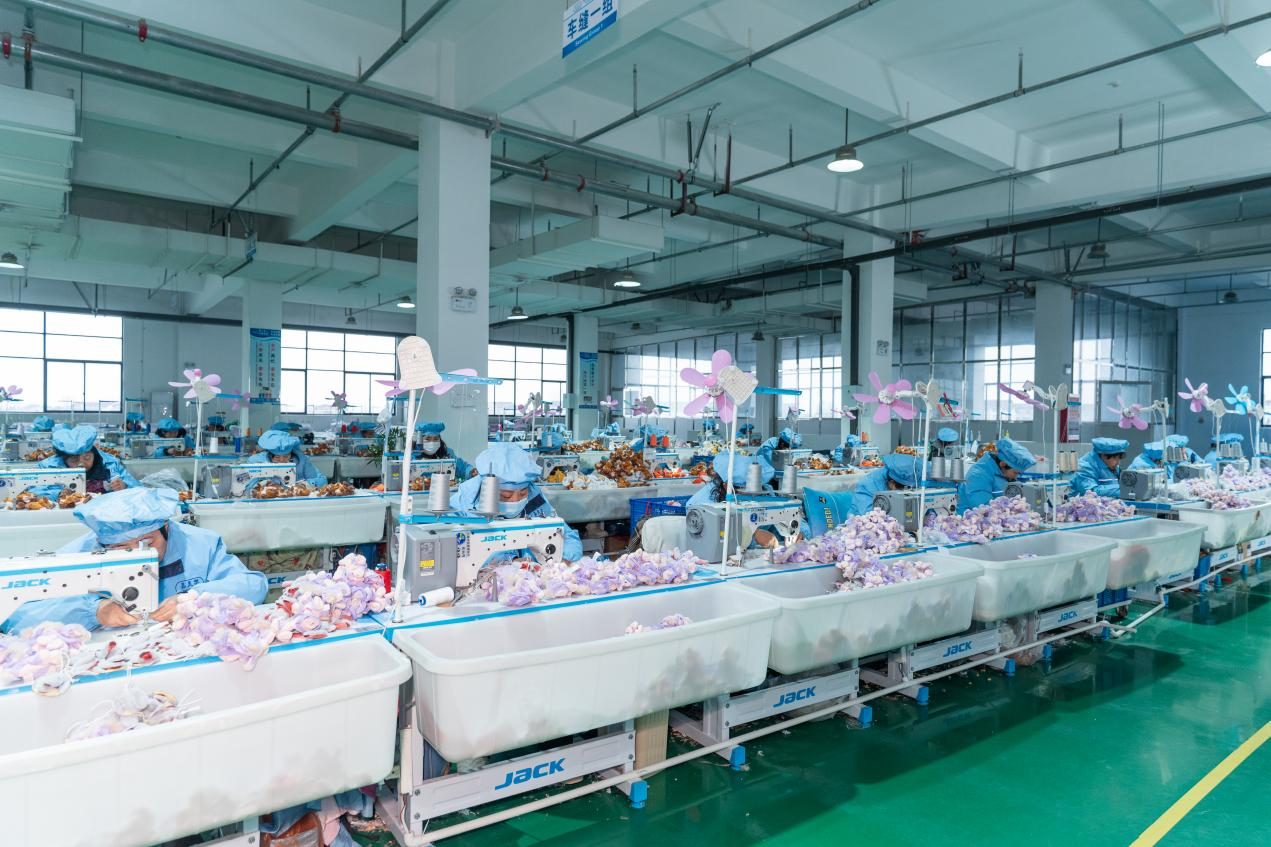
Jiameile (Tianchang Jiameile Gifts Co., Ltd.) is a pet toy manufacturer based in Tianchang, Anhui Province, China, with more than 20 years of plush and textile toy production experience. The company provides OEM and ODM customization, supporting pet brands, wholesalers, and retailers with fabric, size, color, stuffing, squeaker, packaging, and hang tag specification. Jiameile holds ISO 9001, ISO 14001, ICTI, BSCI, and Disney FAMA certifications, and its products comply with international safety standards such as EN71, ASTM F963, and GB6675. Pet toys form a stable product line covering plush pet toys, squeaky toys, and interactive products, serving major markets including the EU and the United States.

Need a Sample or a Custom Range?
If your brand or procurement team is evaluating a dog plush toy range, Jiameile can provide samples, custom fabrics and packaging, and OEM/ODM support. Contact the team at winnie@jml-toys.com or WhatsApp +86 173-7538-5845.
Have Questions or Need More Details?
Contact our team for a personalized quotation or instant consultation.
Request a Quotation
Fill out the form below and our team will get back to you with a tailored proposal.
WhatsApp Direct Chat
Prefer to chat in real-time? Message us on WhatsApp for instant assistance & quick answers.
- Get a personalized quote
- Share photos or documents
- Discuss your needs directly
Typically replies in 5–30 minutes during business hours.