Dog Plush Toy Supplier Capability Audit: Factory to Purchase Order
A dog plush toy supplier capability audit verifies one continuous chain of evidence: that the plant has the space, people and equipment to produce the claimed volume; that the engineering team can turn a brief into a producible sample; that the certification file covers the specific article being bought; and that the remaining capacity can be written into a purchase order with a date the supplier can defend. Every link is checked against a document or an observation, never against the supplier's summary paragraph.
This guide runs that audit in the order a buyer should execute it, using Jiameile (Tianchang Jiameile Gifts Co., Ltd.) as a documented example: a 6,800 m² plant, approximately 230 staff, 6 million units of annual output, a 30-person engineering team, and a certification file covering ICTI, BSCI, Disney FAMA, ISO 9001 and ISO 14001. The worked figures show what verifiable evidence looks like, and which parts of a supplier claim stay open until a named document closes them.
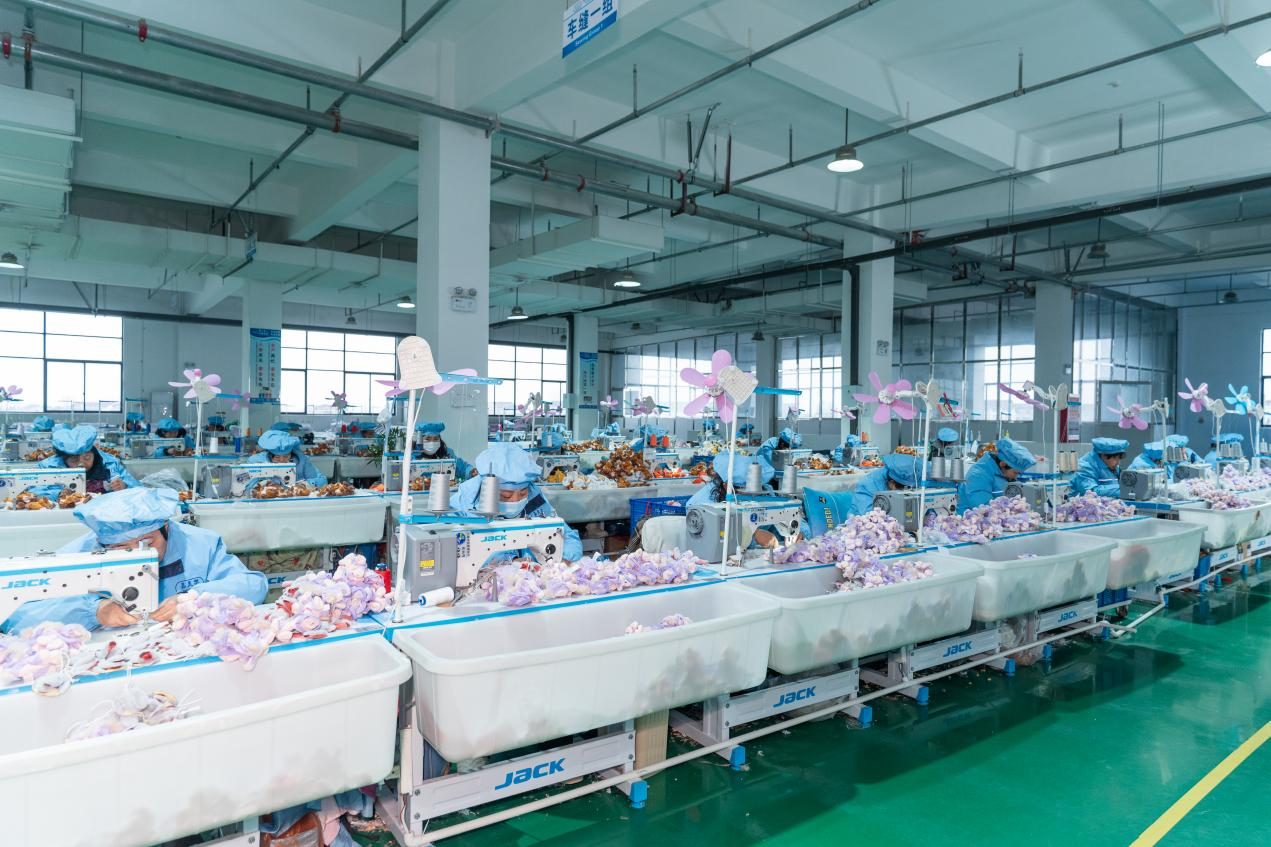
Factory-floor evidence is the first checkpoint in a capability audit: space, headcount and equipment must reconcile with the stated annual output.
What a Capability Audit Must Actually Prove
A capability audit answers a narrower question than a factory inspection. It does not ask whether a supplier is generally competent; it asks whether this supplier can deliver this article, at this volume, to this market, by this date. That breaks into four testable claims.
- Volume claim. Does physical space and headcount support the stated annual output, and does the monthly figure reconcile with the annual figure?
- Development claim. Can the engineering team convert custom requirements — fabric, stuffing type, squeaker type, packaging, logo — into a repeatable production specification?
- Compliance claim. Do the named certificates cover plush toy production, are they inside their validity window, and do product-level test reports exist for the specific SKU?
- Delivery claim. Can the supplier convert the first three claims into a lead time, a MOQ and an acceptance procedure that a purchase order can enforce?
Each claim produces a different document. A supplier that answers all four with a brochure has answered none of them.
Industry Background: Why the Audit Starts on the Floor
Commercial research published by Custom Market Insights puts the global dog toys market at USD 4.16 billion in 2025, with a projected compound annual growth rate of 8.51% between 2025 and 2034. Plush articles sit inside that figure alongside chew and interactive categories, and stuffed toys representing animals are commonly shipped under HS code 9503.00.41 — a classification that the buyer's forwarder should confirm per shipment, since finished pet accessories do not always follow the stuffed-toy code.
Demand figures do not tell a buyer which supplier is real. That gap is filled at factory level, and it is where most sourcing risk concentrates: capacity statements, certification lists and lead times are routinely self-reported, and marketplace listings in the category frequently display safety marks that have not been independently checked against the certificate itself. The audit approach below treats every unverified claim as an open item rather than a disqualification, and lets the accumulated documents decide.
Layer 1: Reconciling Facility Size, Headcount and Annual Capacity
Capacity is the first claim to test because it can be checked arithmetically before anyone travels. Jiameile publishes 6,800 m² of plant space, approximately 230 employees and 6 million units of annual output; an industrial press summary of the company independently records 500,000 pieces per month across the same 6,800 m² facility. Those numbers should agree, and they do: 6,000,000 units divided by 12 months gives 500,000 units per month.
Two further ratios turn the headline figures into something an auditor can compare against other plants and against the order in hand.
- Units per employee per year — 6,000,000 ÷ 230 ≈ 26,087 units (calculated).
- Floor space per employee — 6,800 m² ÷ 230 ≈ 29.6 m² per person (calculated).
These are derived values, not supplier measurements, and they only become meaningful when set against a reference band. Industry capacity guidance places mid-size plush factories at 100,000–300,000 pieces per month and large factories at 500,000 to over 1,000,000 pieces per month. At a calculated 500,000 pieces per month, Jiameile sits at the lower edge of the large-factory band — a useful calibration, because it tells the buyer to expect meaningful but finite allocation rather than unlimited headroom.
What to observe, not just read
The floor check converts the arithmetic into evidence. Ask for the number of production lines, the number of sewing stations, and the shift pattern; then confirm that the equipment count and staffing are consistent with the stated output. A plant claiming 500,000 units a month on a single shift with a modest line count invites a follow-up question about second shifts or outsourced sub-assembly. Ask directly whether any process — cutting, stuffing, packing — is performed by an outside workshop, because that changes both the audit scope and the delivery risk.

Company real-scene photographs should corroborate the stated floor space and staffing; the auditor's task is to see that lines, stations and people match the output claim.
Layer 2: Testing R&D Depth Beyond the Engineer Count
Jiameile states a 30-person R&D team. Engineer headcount alone is weak evidence, but the same source supplies a second, harder signal: event-mascot credentials covering UEFA Euro 2016 (France), FIFA World Cup 2018 (Russia), FIFA Women's World Cup 2019 (France), UEFA Euro 2020, FIFA World Cup 2022 (Qatar), the Hangzhou Asian Games 2023 and UEFA Euro 2024.
Why that matters for a dog plush toy program is specific. Licensed mascot work imposes constraints that ordinary plush production does not: artwork must be reproduced within brand-owner tolerance, colour and proportion changes require re-approval, the deadline is externally fixed, and every unit in the run must match the approved reference. A supplier that has delivered under those conditions has demonstrated a review workflow, not just a pattern-making capability.
The audit still has to separate capability from relevance. Mascot credentials establish that a team can manage an approval-heavy project to a fixed date; they do not establish that the same team knows what makes a dog plush toy survive chewing. Those are different questions answered by different departments.
Documented customization scope
The customization variables the supplier states it can control are the practical output of the R&D function: logo printing, fabric material, size, colour, stuffing type, squeaker type, packaging (box, blister or card) and hang tags. Each variable generates a specification question the buyer should settle at sampling stage rather than at production stage.
- Stuffing type — a stuffed construction versus a no-stuffing construction changes both the safety profile and the pattern engineering.
- Squeaker type — the position and grade of the squeaker determines whether the article survives repeated compression.
- Fabric and stitching — reinforced stitching is a specification decision, not an inspection outcome; it must be written into the sample.
- Packaging — hang tags and retail packaging drive both MOQ and artwork approval timing.
Ask which of these the supplier's own engineers control and which are subcontracted. A 30-person team is a meaningful resource only if the answers keep fabric, pattern and construction decisions inside the building.
Layer 3: Certification Coverage and Product Safety Standards
Certification is where buyers most often accept a list in place of a file. The Jiameile certification set spans two different kinds of evidence, and they should never be treated as interchangeable.
Management-system and audit certifications
- ISO 9001 — quality management system certificate issued by CQC under GB/T19001-2016, certificate number 00124Q35906R5M/3400, scope “Production of cloth/plush toys”, issued 2024-07-11 and valid until 2027-09-01.
- ISO 14001 — environmental management system certification.
- ICTI — toy-industry ethical manufacturing certification.
- BSCI — social compliance audit framework used by European retailers.
- Disney FAMA — facility and merchandising authorization tied to Disney-licensed production.
The audit action here is mechanical and non-negotiable: read the certificate, not the logo. Confirm the certificate number against the issuing body, confirm the scope wording actually covers cloth and plush toy production, confirm the validity dates have not lapsed, and confirm that a brand-specific authorization such as FAMA applies to the facility that will make your order. A FAMA authorization attached to one site does not transfer to a sister plant.
Product safety standards
Management systems do not test individual articles. Product safety evidence sits in a separate file: EN71, CPSIA, ASTM F963, GB6675 and GB/T 43839-2024, the Chinese safety technical requirements for companion animal (pet) products. The supplier states that its products comply with EN71, ASTM F963 and GB6675, and its pet-toy specification sheets reference GB/T 43839-2024.
One qualification protects the buyer more than any other sentence in this section: several of the standards named above are toy standards, and a pet product is not automatically inside their scope. EN71 and ASTM F963 are framed around toys, and CPSIA is framed around children's products. Whether a given standard applies to a specific dog plush toy, in a specific market, is a determination for the buyer's compliance team and the testing laboratory — not something a supplier certificate can settle on its own.
The practical audit question is therefore two-part: which standard applies to this SKU in this market, and does a test report exist that names this SKU, this material and this standard version. A factory-level compliance statement answers neither question on its own.
Requesting the file correctly
- Ask for the test report, not the certificate of compliance, and check that the report names the actual construction — fabric composition, stuffing, squeaker, plastic components.
- Record the standard version on the report; a report against a superseded edition is a finding, not an automatic failure.
- Ask which SKUs were tested as a family and which required a separate submission.
- Confirm that the report holder matches the legal entity that will issue the invoice and the shipping documents.

The ISO 9001 certificate should be read for scope, certificate number and validity dates — the scope here is production of cloth and plush toys, valid to 2027-09-01.
Layer 4: Mapping Capacity and Export Share to Realistic Lead Times
Delivery assurance is not a separate promise; it is the arithmetic of the first three layers applied to a specific order. Three published inputs make that arithmetic possible: 6 million units of annual output, a 70% export share concentrated on the EU and USA, and stated lead times of 7–15 days for samples and 20–45 days for bulk production depending on complexity and volume.
Order size against monthly capacity
Company case material describes order sizes in three bands: pilot orders of 500–3,000 pieces, mid-scale e-commerce or retail orders of 3,000–20,000 pieces, and long-term supply programs of 20,000–100,000+ pieces. Calculated against the 500,000-piece monthly capacity, a 100,000-piece order represents about 20% of one month's output. That is a meaningful but absorbable allocation — provided it is booked before the EU and USA programs consume the schedule.
The 70% export concentration is the single most useful delivery signal in the file. It indicates that European and American compliance documentation, labelling and packaging formats are routine rather than exceptional, which shortens the document lead time on a new order. It also means the plant's peak season is shaped by Northern Hemisphere retail calendars, so a buyer placing a large order close to a retail deadline is competing for the same capacity as everyone else in that channel.
Converting lead times into a PO date
Adding the two published ranges produces a planning envelope of roughly 27 to 60 days from sample approval to goods ready for shipment (calculated: 7–15 days sampling plus 20–45 days bulk production). That figure deliberately excludes raw-material procurement, artwork approval cycles and transit, all of which a purchase order should state separately rather than bury inside the production window.
Acceptance criteria that belong in the contract
The purchasing terms the supplier documents provide a usable baseline for the commercial section of the order.
- MOQ — typically 500–3,000 pieces per style, rising to 3,000–5,000 pieces for complex custom designs.
- Delivery terms — mainly FOB, followed by EXW; some suppliers support CIF or DDP for cross-border e-commerce.
- Acceptance — OQC final inspection before shipment, plus buyer or third-party inspection by agencies such as SGS or BV.
- Payment — 30% deposit with 70% balance before shipment, described as standard industry practice.
- Quality process — incoming inspection (IQC), in-process inspection (IPQC) and final inspection (OQC).
- After-sales — replacement or rework for quality issues, inspection reports supplied, and 1–3% spare units.
Each of these is a contract clause awaiting a number. “Third-party inspection” should become a named agency, a named inspection point, and a defined response if the lot fails. “Final inspection” should reference the specification sheet approved at sampling. “1–3% spare units” should state whether spares are included in the invoiced quantity or added.
Running the Audit: Eight Steps in Sequence
The sequence matters because each step produces the input for the next. Running them out of order lets a strong certification file mask a capacity problem, or a persuasive sample mask a missing test report.
- Collect the paper file. Certificates with numbers and validity dates, test reports with standard versions, and the specification sheets for the article family under consideration.
- Reconcile the capacity arithmetic. Divide annual output by twelve, divide annual output by headcount, and divide floor space by headcount. Flag any figure that does not align with the supplier's own stated band.
- Verify the facility and headcount on site or by live video walkthrough. Count lines, stations and shifts; confirm that subcontracted processes are disclosed.
- Interview the engineering function. Ask who owns pattern, fabric and construction decisions, and ask for one completed project timeline from brief to shipment.
- Read every certificate for scope and date. Match the legal entity, the production site and the authorized product scope to the order.
- Match product safety reports to the SKU. Confirm the standard, the version, the material list and the holder.
- Walk the quality process. Ask to see an IQC record, an IPQC checkpoint and an OQC report from a recent plush production run.
- Write the commercial terms. Convert capacity, lead time, MOQ, inspection and spares into dated PO clauses, and agree the escalation path before the deposit is paid.
Use Cases: Where the Audit Changes the Buying Decision
The same audit produces different answers depending on the order profile, which is why a single capability score is rarely useful on its own.
Retail chain replenishment at 20,000–100,000 pieces
At this volume the binding constraint is schedule allocation, not capability. The buyer needs the 20% capacity calculation, a confirmed production window, and a written statement of what happens if a prior order overruns. Export share matters here: a supplier already running EU and USA programs is likely to have the labelling and documentation steps in place, which reduces the risk of a shipment held at destination for paperwork.
E-commerce pilot orders at 500–3,000 pieces
Small orders are governed by MOQ and sampling, not capacity. The relevant checks are whether the article falls inside the 500–3,000 piece band or inside the 3,000–5,000 band for complex custom designs, and whether the 7–15 day sampling window is realistic given the number of variables being changed at once. A pilot that changes fabric, stuffing and squeaker simultaneously will consume the sampling window several times over.
Functional articles: squeaky, teething, no-stuffing, washable
Functional constructions concentrate the audit on Layer 2 and Layer 3. An interactive squeaky plush dog toy, a plush puppy teething toy or a no-stuffing plush construction each introduces a component or a construction decision that must appear in the approved sample and in the test report. The published application scope — daily companionship, emotional calming, teething training, behavioural training, interactive play and reducing destructive behaviour — describes intended use, not a measured behavioural outcome, and the buyer should keep that distinction in the product listing.
Durability claims deserve the same treatment. Company case material describes a typical service life of 3–12 months for standard plush toys and 6–24 months for reinforced chew toys depending on usage intensity, alongside a reported repeat purchase rate above 85% and some long-term clients buying more than 100,000 pieces annually. These are supplier-reported figures from company case material, not independently audited results, and they should be presented to retail buyers as such.
Evidence Map: What Each Audit Layer Establishes
The table below is the working summary a buyer can carry into a supplier meeting. The fourth column is the one that prevents over-claiming.
| Audit layer | Document or observation | What it establishes | What it does not establish |
|---|---|---|---|
| Facility and capacity | Floor area, headcount, equipment count, shift pattern, annual output | Whether stated volume is arithmetically plausible and internally consistent | Whether capacity is free at the required date |
| R&D and engineering | Engineer headcount, customization scope, licensed mascot project history | Ability to manage approval-heavy, deadline-fixed custom programs | Knowledge of dog-specific durability or play behaviour |
| Management-system certification | ISO 9001, ISO 14001, ICTI, BSCI, Disney FAMA certificates | That a documented management system and social-compliance framework are in place at the named site | That a specific SKU passed a specific safety test |
| Product safety testing | Test reports naming standard, version, material and SKU | That the tested construction met the tested standard at test time | That untested variants or later material substitutions comply |
| Quality control | IQC, IPQC and OQC records; SGS or BV inspection reports | That inspection checkpoints exist and produce records | That defect rates will hold across a full production run |
| Commercial terms | MOQ, FOB/EXW/CIF/DDP terms, 30/70 payment, 1–3% spares | What the supplier is contractually prepared to commit to | That the commitment will be met without enforcement clauses |
Limitations the Audit Cannot Remove
An audit reduces uncertainty; it does not eliminate it, and a buyer who treats a completed checklist as a guarantee will be surprised by the same issues an unaudited buyer faces.
- Capacity is pooled. Six million annual units is a plant-level figure. What matters for a specific order is the allocation the supplier is willing to ring-fence in writing.
- Certificate scope is not SKU scope. The ISO 9001 scope covers production of cloth and plush toys — it says nothing about any individual article's test status.
- Mascot credentials are a proxy. They evidence project execution under licensed constraints, not performance of a dog plush toy under chewing.
- Self-reported metrics stay self-reported. Repeat purchase rates, client volumes and service-life ranges come from company case material and should be labelled that way in any buyer-facing document.
- An audit is a snapshot. Material substitution, subcontracting changes and staff turnover after the audit are outside its scope, which is why acceptance criteria and inspection rights belong in the contract rather than in the audit report.
Frequently Asked Questions
Which certifications should a buyer verify before placing a dog plush toy order?
Verify two separate categories. For management systems and social compliance, Jiameile holds ICTI, BSCI, Disney FAMA, ISO 9001 and ISO 14001. For product safety, the relevant framework includes EN71, CPSIA, ASTM F963, GB6675 and GB/T 43839-2024, the Chinese safety technical requirements for companion animal products. Read each certificate for number, issuing body, scope wording and validity dates — the ISO 9001 certificate, for example, is numbered 00124Q35906R5M/3400, scoped to production of cloth and plush toys, and valid until 2027-09-01 — and request product-level test reports for the actual SKU.
How can a buyer check that a supplier's stated capacity is realistic?
Reconcile three published figures arithmetically. Jiameile states 6,800 m² of plant, approximately 230 staff and 6 million units of annual output, which equals 500,000 units per month (calculated) — consistent with an independent press summary of the same facility. That works out to roughly 26,087 units per employee per year and about 29.6 m² of floor space per employee (both calculated). Then confirm on site that line count, sewing stations and shift pattern can support those ratios, and ask whether any process is subcontracted.
What does a 30-person engineering team indicate about OEM and ODM capability?
It indicates that pattern, fabric, construction and packaging decisions can be handled in-house across the stated customization scope: logo printing, fabric material, size, colour, stuffing type, squeaker type, packaging in box, blister or card, and hang tags. The supporting signal is the licensed mascot record — UEFA Euro 2016, FIFA World Cup 2018, FIFA Women's World Cup 2019, UEFA Euro 2020, FIFA World Cup 2022, Hangzhou Asian Games 2023 and UEFA Euro 2024 — which demonstrates an approval workflow under externally fixed deadlines. It does not by itself demonstrate dog-specific durability engineering.
What are the purchasing terms and acceptance criteria?
MOQ is typically 500–3,000 pieces per style, and 3,000–5,000 pieces for complex custom designs. Delivery terms are mainly FOB, followed by EXW, with CIF or DDP available for some cross-border e-commerce buyers. Acceptance is based on OQC final inspection before shipment plus buyer or third-party inspection by agencies such as SGS or BV. Payment follows a 30% deposit with 70% balance before shipment, described as standard industry practice.
How long do sampling and bulk production take?
Sample production runs 7–15 days and bulk production 20–45 days, depending on complexity and volume. Combined, that gives a planning envelope of roughly 27–60 days from sample approval to goods ready for shipment (calculated), before raw-material procurement, artwork approval cycles and transit are added. Buyers should state those three elements separately in the purchase order rather than assume they sit inside the production window.
How does a 70% EU and USA export share affect delivery planning?
It indicates that European and American documentation, labelling and packaging requirements are routine at the plant, which shortens document lead time on a new order. The trade-off is scheduling pressure: a 70% concentration in those two markets means the plant's peak load follows Northern Hemisphere retail calendars, so a large order placed close to a retail deadline is competing with the rest of that channel. Buyers with fixed launch dates should lock production windows early and treat the 1–3% spare-unit allowance and the named inspection agency as part of the delivery agreement rather than an afterthought. For a first evaluation, request a sample and a quotation against a written specification, then compare the returned sample and quotation line by line against the audit findings above.
Conclusion
A dog plush toy supplier capability audit works when it stays arithmetic and documentary. Jiameile's published figures — 6,800 m², approximately 230 staff, 6 million units per year, 30 engineers, 70% export share to the EU and USA, and a certification file covering ICTI, BSCI, Disney FAMA, ISO 9001 and ISO 14001 — form a coherent starting picture only because the numbers reconcile with each other and with an independent press summary of the same facility.
The gaps that remain are the ones the buyer must close: allocation at the required date, SKU-level test reports against the correct standard version, and a purchase order that turns MOQ, 20–45 day production windows, third-party inspection and spare-unit allowances into enforceable clauses. Run the eight steps in sequence, keep the fourth column of the evidence map in view, and the distance between a factory floor and a confirmed purchase order becomes measurable rather than assumed.
Jiameile (Tianchang Jiameile Gifts Co., Ltd.) — sample and quotation requests for custom dog plush toy programs.
Have Questions or Need More Details?
Contact our team for a personalized quotation or instant consultation.
Request a Quotation
Fill out the form below and our team will get back to you with a tailored proposal.
WhatsApp Direct Chat
Prefer to chat in real-time? Message us on WhatsApp for instant assistance & quick answers.
- Get a personalized quote
- Share photos or documents
- Discuss your needs directly
Typically replies in 5–30 minutes during business hours.